Can a Battery Remove Salt from Seawater?
A Journey Through My Graduation Project on Desalination Batteries
When we hear the word battery, we usually think about storing electricity. From smartphones and laptops to electric vehicles and renewable energy systems, batteries have become an indispensable part of modern life. Their role seems straightforward: store electrical energy when it is available and deliver it when it is needed.
But what if a battery could do something beyond energy storage?
What if it could also remove salt from seawater?
At first glance, the idea sounds counterintuitive. Water desalination is typically associated with membranes, high-pressure pumps, or thermal processes—not electrochemical cells. Yet over the last decade, researchers have begun exploring a new class of technologies that combine electrochemistry with water treatment. Among these emerging concepts, desalination batteries have attracted growing attention because they offer the intriguing possibility of coupling ion removal with battery-like electrochemical reactions.
This was exactly the question that motivated my graduation project at the Department of Chemical Engineering, Gebze Technical University. Together with my teammate Refik Sargun, I investigated whether 9,10-anthraquinone (AQ)-based organic electrodes could operate electrochemically in natural seawater and whether this electrochemical activity could produce measurable changes in seawater conductivity. Rather than developing a commercial desalination device, our goal was to better understand the electrochemical behavior of AQ-based electrodes and evaluate their potential within a desalination battery system.
This article is not intended to be a condensed version of my graduation thesis. Instead, I would like to take you through the engineering perspective behind the project: why desalination batteries are being studied, how this technology works, why we selected anthraquinone as our active material, how our experimental methodology evolved throughout the study, and what I learned from the process as a chemical engineering student.
By the end of this article, I hope you will not only understand what a desalination battery is, but also gain a clearer picture of how an engineering research project develops—from identifying a problem and designing experiments to interpreting results with scientific caution.
Why Do We Need a New Desalination Technology?
For most of us, turning on a tap and getting clean drinking water feels completely ordinary. We rarely stop to think about the amount of infrastructure, technology, and energy required to make that possible. Yet behind every glass of freshwater lies a surprisingly complex engineering challenge
One of the defining challenges of this century is that the demand for both freshwater and energy continues to grow simultaneously. Population growth, rapid urbanization, industrial development, and climate change are placing increasing pressure on freshwater resources, while the processes used to secure clean water often require significant amounts of energy. This interdependence is commonly referred to as the Water–Energy Nexus a concept highlighting that producing clean water requires energy, while producing energy itself often depends on reliable water resources.
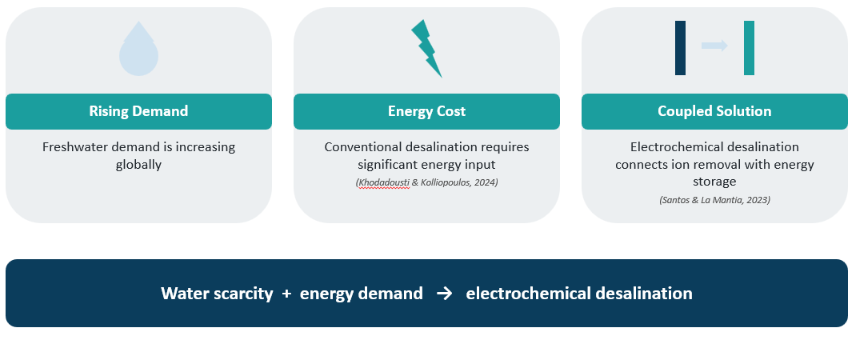
For decades, conventional desalination technologies such as reverse osmosis (RO) and thermal desalination have played a crucial role in supplying freshwater, particularly in regions where natural freshwater resources are limited. These technologies are highly effective and have reached a remarkable level of industrial maturity. However, they also rely on energy-intensive processes such as high-pressure pumping or thermal input, motivating researchers to explore complementary approaches that may improve overall sustainability under specific conditions.
Among these emerging approaches, electrochemical desalination has become an increasingly active research area. Instead of separating salt from water through pressure-driven membranes or evaporation, electrochemical systems use electrical energy to manipulate ions directly. Within this family of technologies, one concept is particularly intriguing: the desalination battery. Unlike conventional batteries that are designed solely to store and release electrical energy, desalination batteries use battery-like electrochemical reactions to temporarily remove ions from saline water during operation.
At first, the idea sounds almost paradoxical a battery that contributes to water desalination. Yet this seemingly unusual combination of electrochemistry and water treatment has opened an entirely new research direction over the past decade. Before discussing the experiments from my graduation project, it is worth understanding how this technology actually works.
What Exactly Is a Desalination Battery?
At first glance, a desalination battery looks surprisingly similar to a conventional electrochemical cell. It has electrodes, an electrolyte, and an external circuit through which electrons flow. However, unlike a traditional battery whose primary purpose is energy storage, a desalination battery is designed to temporarily remove dissolved ions from saline water while undergoing electrochemical charge and discharge reactions. In other words, the movement of ions is no longer just a consequence of battery operation it becomes the main objective of the system.
The operating principle of a desalination battery is commonly described as a four-step cycle. The process begins with electrodes that are ready to interact with seawater. During the discharge step, electrochemical reactions drive sodium and chloride ions out of the electrolyte and into the electrode materials, reducing the salt concentration of the surrounding solution. Once this desalination step is completed, the treated water can be removed and replaced with a fresh batch of seawater. The battery is then recharged, releasing the stored ions from the electrodes and regenerating the system for the next desalination cycle. This sequence allows the same cell to repeat the desalination process multiple times through reversible electrochemical reactions.
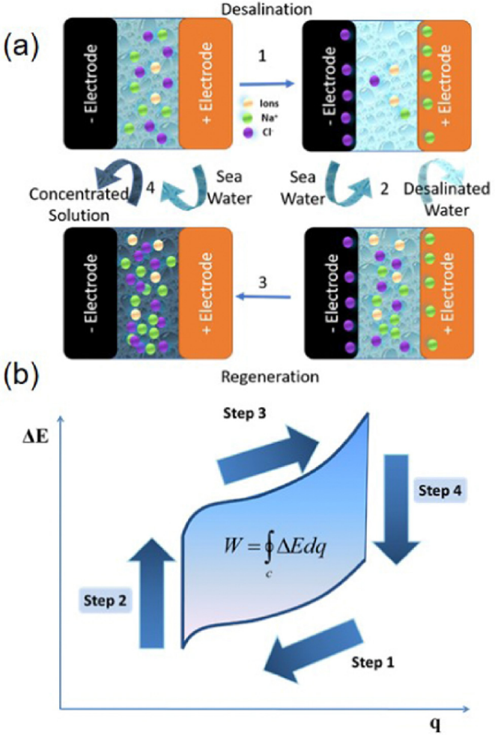
One important aspect distinguishes desalination batteries from another well-known electrochemical desalination technology: capacitive deionization (CDI). In conventional CDI systems, ions are mainly stored electrostatically within the electrical double layer formed on porous carbon electrodes. Desalination batteries, on the other hand, rely on Faradaic reactions, where ions participate directly in reversible redox processes occurring inside or at the surface of electrochemically active materials. Because ions become part of these electrochemical reactions rather than being stored only through electrostatic attraction, Faradaic electrodes have attracted considerable attention as a promising route toward higher ion-storage capabilities.
This distinction is exactly what makes desalination batteries such an exciting research field. Instead of viewing water desalination and electrochemical energy storage as two completely separate technologies, desalination batteries bring them together within the same electrochemical framework. Understanding this operating principle was the first step before we could begin asking a more specific question: which electrode material should we choose for our own system?
Why Did We Choose Anthraquinone?
Every desalination battery is built around one fundamental component: the electrode material. Regardless of how sophisticated the cell design is, its overall performance ultimately depends on how effectively the electrodes can undergo reversible electrochemical reactions while interacting with ions in the electrolyte. Choosing the right active material is therefore one of the most important decisions in designing a desalination battery.
A wide variety of electrode materials have been investigated for electrochemical desalination, ranging from inorganic intercalation compounds to organic redox-active molecules. For our graduation project, we focused on 9,10-anthraquinone (AQ), a small organic molecule that has attracted increasing interest in aqueous electrochemical systems because of its reversible redox chemistry and structural simplicity. Rather than selecting AQ based solely on its reported electrochemical performance, we were interested in understanding how this material behaves specifically in natural seawater, where the electrolyte is considerably more complex than the model solutions commonly used in laboratory studies.
The electrochemical activity of anthraquinone originates from its carbonyl (C=O) functional groups. During electrochemical cycling, these redox-active sites can reversibly participate in electron-transfer reactions while interacting with ions and protons in the surrounding aqueous electrolyte. This reversible behavior is what makes anthraquinone an attractive candidate for aqueous battery applications and, consequently, for desalination battery research.
However, anthraquinone also comes with an important limitation: it is intrinsically a poor electronic conductor. An electrode made of pure AQ would not provide efficient pathways for electrons to move throughout the material, leading to poor electrochemical performance. To overcome this limitation, conductive carbon must be incorporated into the electrode structure. In our study, Ketjenblack (KB) served as the conductive network, creating electrically connected pathways between AQ particles, while the polymer binder provided the mechanical integrity required to maintain a stable electrode throughout electrochemical cycling. Rather than acting as electrochemically active materials themselves, these additional components enable AQ to function effectively inside the electrochemical cell.
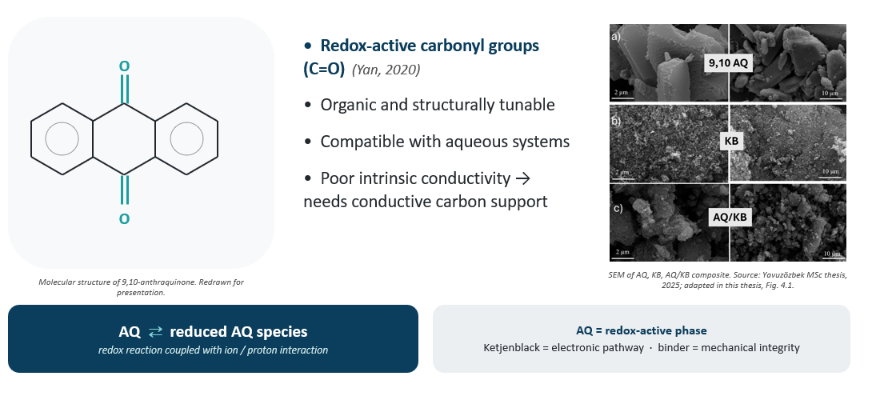
This combination of a redox-active organic material, a highly conductive carbon additive, and a polymer binder formed the foundation of every experiment presented in this project. Before evaluating electrochemical performance or monitoring conductivity changes, the first step was therefore to fabricate electrodes capable of operating reliably in seawater.
From Concept to Laboratory: Designing Our Experimental Strategy
Once we understood how desalination batteries operate and selected anthraquinone as our active material, the next challenge was designing an experimental strategy capable of answering our research question.
At first, the problem seemed relatively straightforward: assemble a cell, perform electrochemical cycling, and monitor whether the conductivity of seawater changes during operation. However, we quickly realized that answering such a question requires much more than simply collecting experimental data. A decrease in conductivity alone does not automatically prove electrochemical ion removal. It first has to be demonstrated that the observed response is genuinely associated with electrochemical processes rather than other phenomena occurring inside the system.
This realization shaped the entire methodology of our project.
Instead of trying to answer every question with a single experiment, we divided the study into a sequence of smaller questions, where each stage was designed to verify one aspect of the system before moving to the next.
Our experimental workflow followed five consecutive steps:
- Fabricate AQ/KB-based electrodes capable of operating in aqueous seawater electrolytes.
- Verify electrochemical activity using a conventional two-electrode Swagelok cell.
- Monitor conductivity in real time with a modified T-type cell during electrochemical cycling.
- Improve electrochemical interpretation by introducing a three-electrode configuration with a reference electrode.
- Compare the information obtained from different cell configurations to better understand both the strengths and limitations of each experimental approach.
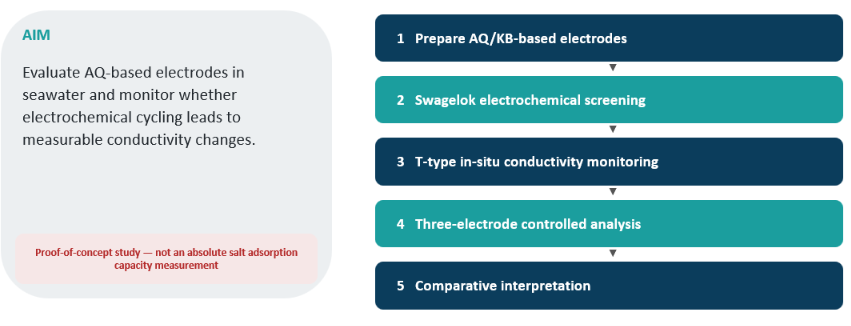
Looking back, I think this stepwise methodology became one of the most valuable aspects of the project. Rather than treating every experiment as an isolated measurement, each configuration answered a different engineering question and provided the foundation for the next stage of the study. In other words, the project was not simply about obtaining conductivity data—it was about building enough confidence to interpret those data correctly.
The following sections describe how each experimental configuration contributed to that process and why changing the cell design became just as important as improving the electrode itself.
Building the Electrode: More Than Just Mixing Materials
Before any electrochemical measurements could begin, we first needed to build an electrode capable of operating in seawater. At first glance, this may sound like a straightforward preparation step. In reality, however, electrode fabrication is already part of the engineering design process.
An electrochemically active material alone is rarely sufficient to produce a functional electrode. Even if a material exhibits excellent redox properties, it still requires efficient electronic pathways, mechanical stability, and intimate contact between all components in order to operate reliably during repeated cycling.
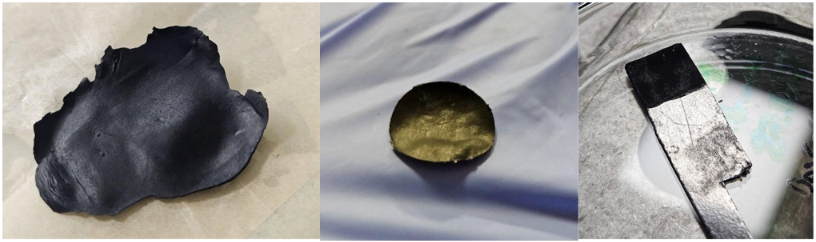
For this reason, our electrodes were not composed of anthraquinone alone. Instead, we prepared composite electrodes in which anthraquinone (AQ) served as the redox-active material, Ketjenblack (KB) provided electronic conductivity, and the polymer binder maintained the structural integrity of the electrode throughout electrochemical cycling. Each component had a distinct role, and removing any one of them would fundamentally change how the electrode behaves inside the electrochemical cell.
Another important aspect of our study was that we employed two different electrode fabrication approaches depending on the experimental objective. Self-standing electrodes were prepared for the two-electrode Swagelok and T-type cell experiments, whereas slurry-cast electrodes on graphite current collectors were used in the three-electrode configuration. These were not alternative versions of the same experiment; rather, each electrode architecture was selected to match the specific requirements of the corresponding electrochemical setup.
Rather than viewing electrode preparation as a routine laboratory procedure, I came to see it as the first engineering decision in the entire project. Every experiment that followed depended on how successfully this first step was designed.
The First Question: Can Anthraquinone Operate in Natural Seawater?
Before discussing desalination performance, we first had to answer a much more fundamental question.
Can an anthraquinone-based electrode actually operate electrochemically in natural seawater?
Although anthraquinone has been widely investigated in aqueous electrochemical systems, natural seawater presents a considerably more challenging environment than the simplified electrolytes frequently used in laboratory studies. Besides its high ionic strength, seawater contains multiple dissolved ions and naturally occurring impurities that may influence electrochemical behavior. Before interpreting any conductivity changes, we therefore needed to confirm that our electrode could undergo stable electrochemical cycling under these conditions.
To answer this question, we began with the simplest configuration in our experimental workflow: a conventional two-electrode Swagelok cell. The purpose of this setup was not to evaluate desalination performance, but to verify that the AQ-based electrode remained electrochemically active when natural seawater was used as the electrolyte. In other words, this stage served as an electrochemical screening step before introducing more complex experimental configurations.
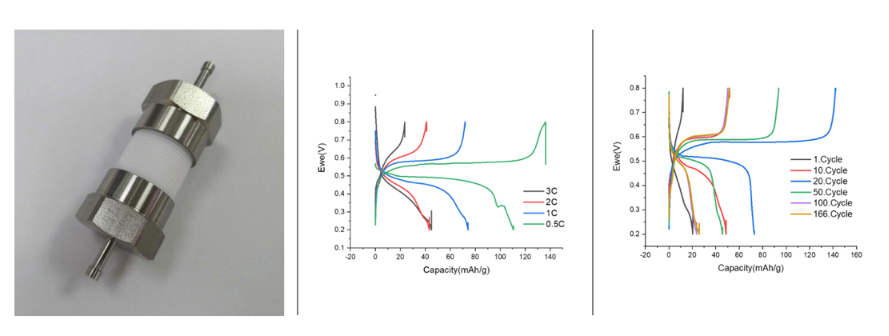
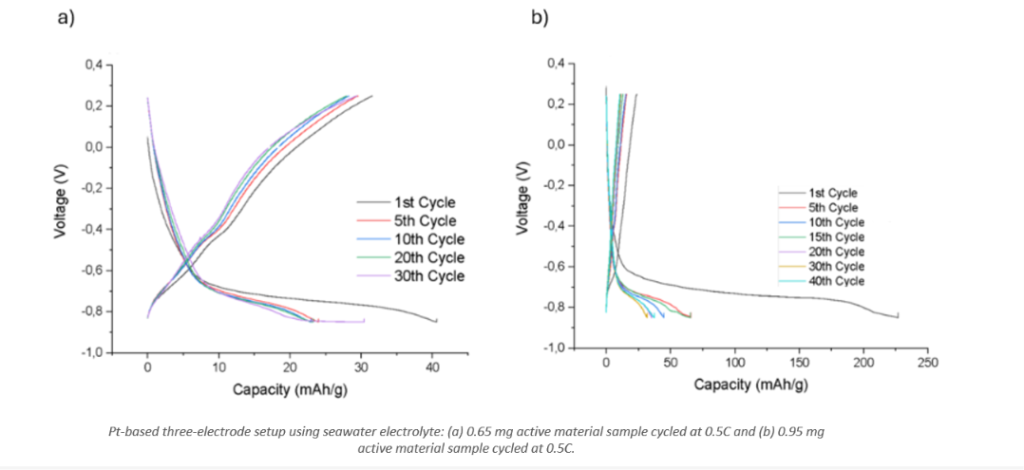
Several charge–discharge rates were examined to identify conditions that produced a clear and stable electrochemical response. Among the tested conditions, 0.5 C provided the most accessible electrochemical behavior and was therefore selected for subsequent experiments. Under these conditions, the AQ-based electrode exhibited reversible galvanostatic charge–discharge profiles over extended cycling, demonstrating that electrochemical operation in natural seawater was indeed possible.
However, an important limitation remained. While the Swagelok cell successfully demonstrated electrochemical activity, it provided no information about whether this activity was accompanied by changes in seawater conductivity. At this stage, we had confirmed that the electrode worked—but we still did not know whether it was actually contributing to desalination.
That unanswered question became the motivation for designing the next stage of the project.
Before Applying Electricity, We Tried to Prove Ourselves Wrong
At this stage, it would have been tempting to move directly to conductivity measurements during electrochemical cycling. After all, if the goal is to investigate desalination, why not simply apply current and observe whether the conductivity decreases?
The answer is surprisingly simple: because a decrease in conductivity does not necessarily mean that electrochemical desalination has occurred.
Before introducing any electrical input, we first wanted to eliminate a much simpler explanation. Could the electrode material itself reduce seawater conductivity without any electrochemical reaction? If the answer were yes, then any conductivity decrease observed during cycling could not be confidently attributed to electrochemical processes alone.
To address this question, we designed a passive adsorption control experiment. AQ/KB-based electrode materials with different masses were immersed in natural seawater for 24 hours without applying any current or potential. If passive ion uptake were the dominant mechanism, we would expect larger amounts of electrode material to produce progressively greater conductivity decreases.
However, this was not what we observed.
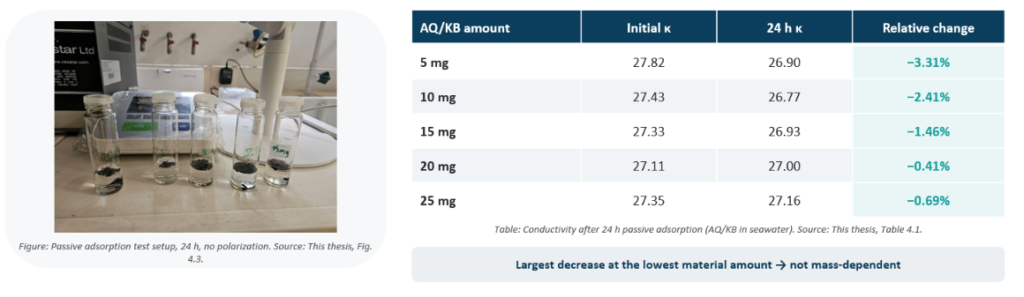
Although small conductivity reductions were detected after 24 hours, they did not follow a systematic trend with increasing material mass. In fact, the largest decrease occurred in the sample containing the smallest amount of AQ/KB material. Under the conditions investigated in this study, these observations did not provide clear evidence for systematic passive ion uptake by the electrode material alone.
This control experiment became one of the most important steps in the entire project. It did not demonstrate desalination by itself—but it significantly strengthened the interpretation of the electrochemical experiments that followed. By showing that passive adsorption alone could not consistently explain conductivity changes, we gained greater confidence that the larger conductivity decreases observed during electrochemical cycling were primarily associated with electrochemical processes rather than simple material–electrolyte contact.
In research, negative or inconclusive results are often just as valuable as positive ones. This experiment reminded me that good engineering is not only about confirming a hypothesis—it is also about systematically ruling out alternative explanations before drawing conclusions.
Monitoring Conductivity in Real Time: The T-Type Cell
The electrochemical screening experiments confirmed that our AQ-based electrode could operate in natural seawater. The passive adsorption control further showed that simple contact between the electrode material and seawater could not consistently explain changes in conductivity under the investigated conditions. These two findings provided the confidence to move to the next stage of the project.
The next question was straightforward:
Could we monitor conductivity while the electrochemical reaction was actually taking place?
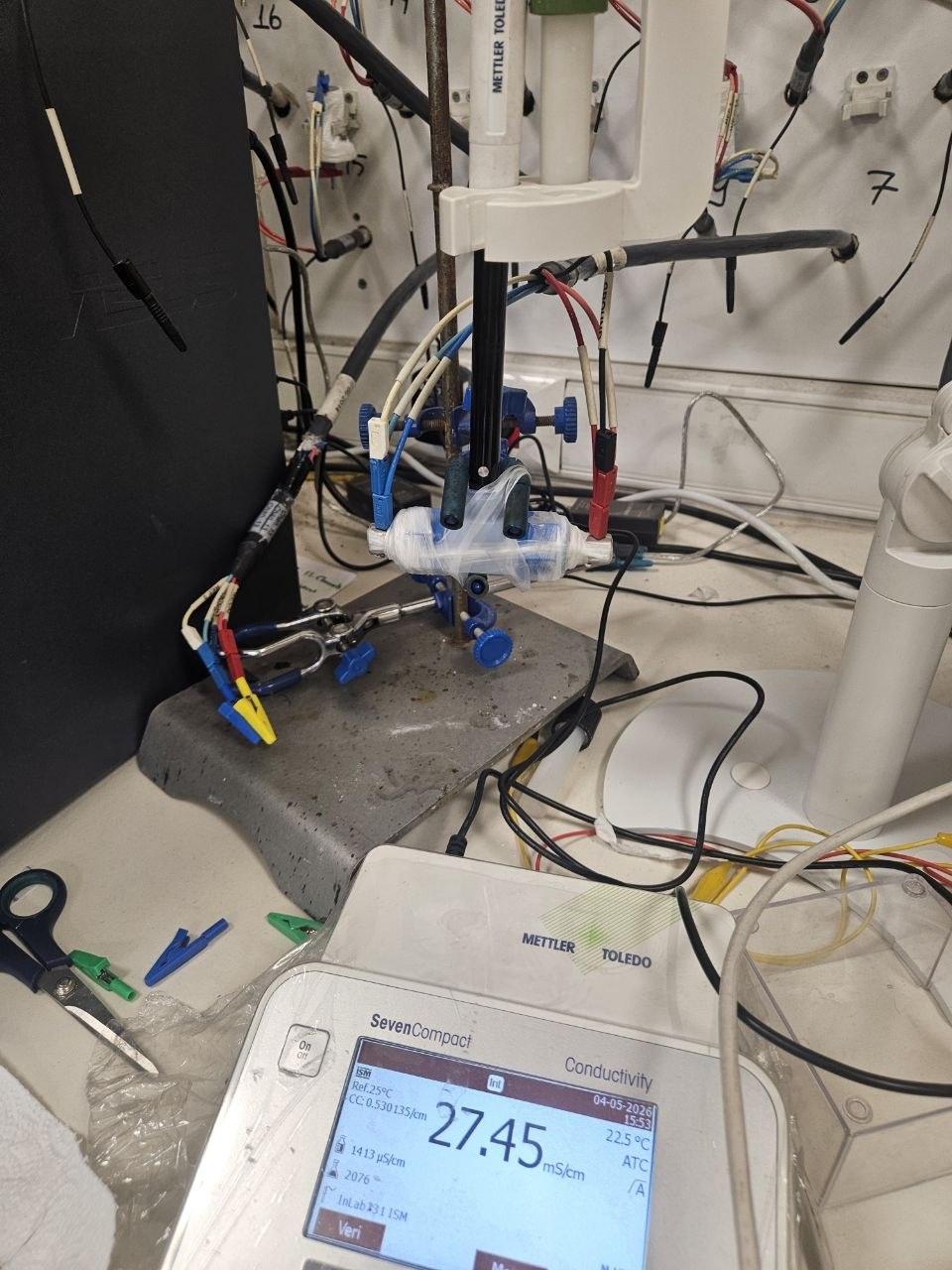
To answer this question, we introduced a modified T-type Swagelok cell, specifically designed to enable in-situ conductivity monitoring during electrochemical cycling. Unlike the conventional two-electrode Swagelok configuration, this setup allowed us to continuously follow how the electrolyte conductivity evolved as the cell underwent charge and discharge. Rather than measuring conductivity only before and after an experiment, we could now observe its behavior in real time.
The results were encouraging. During discharge, the conductivity of the seawater decreased noticeably, indicating that the electrochemical operation of the AQ-based electrode was accompanied by measurable changes in the electrolyte. For the 3.5 mg AQ electrode tested in 1.3 mL of natural seawater, the conductivity decreased from approximately 28 to 16 mS cm⁻¹, corresponding to an apparent relative concentration decrease of 35.65% based on conductivity measurements. A second experiment using a 3.0 mg AQ electrode also exhibited a measurable decrease during the first discharge, reaching 18.58% under the investigated conditions.
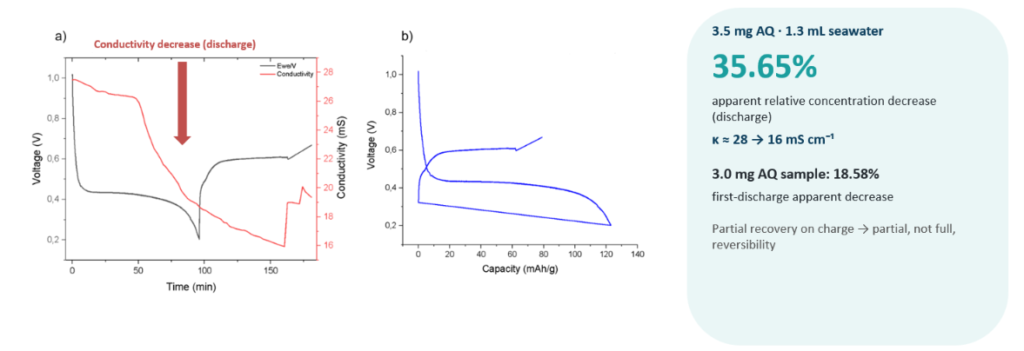
Another interesting observation emerged during the charging step. As the cell was recharged, the conductivity increased again, although it did not fully return to its initial value. This partial recovery suggested that the system exhibited an electrochemically associated response with limited reversibility under the investigated conditions. While these observations were promising, they also highlighted the complexity of interpreting conductivity changes in such systems.
It is important to emphasize that these values should not be interpreted as absolute salt adsorption capacity. Throughout this study, conductivity was used as a semi-quantitative indicator of changes occurring in the electrolyte. Because no ion-specific compositional analyses, such as ICP or ion chromatography, were performed, the calculated values represent conductivity-derived apparent relative concentration changes rather than direct measurements of ion removal.
Although the T-type cell produced the strongest conductivity signal observed in this project, it also raised a new question. The measured response represented the behavior of the entire electrochemical cell, making it difficult to distinguish the contribution of the AQ working electrode from possible effects originating from the counter electrode. Resolving that ambiguity became the motivation for the final stage of our experimental design.
Why We Transitioned to a Three-Electrode System
The modified T-type cell provided the strongest conductivity response observed throughout the project. At first glance, this seemed to answer our research question. However, as we analyzed the data more carefully, another challenge became apparent.
The T-type configuration allowed us to observe changes occurring within the electrochemical cell as a whole, but it did not allow us to distinguish which electrode was primarily responsible for those changes. Since the measured cell voltage reflects the combined behavior of both the working and counter electrodes, interpreting the electrochemical response of the AQ electrode alone remained difficult.
This limitation motivated the final stage of our experimental methodology.
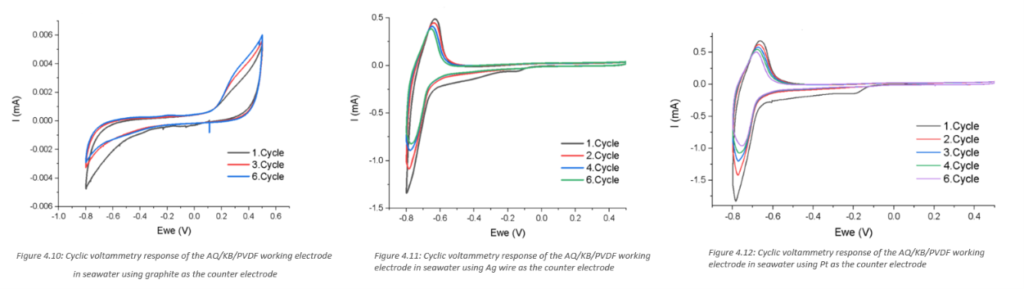
To obtain a clearer picture of the AQ electrode itself, we moved to a three-electrode configuration consisting of an AQ-based working electrode, an Ag/AgCl reference electrode, and different candidate counter electrodes. Before performing further electrochemical experiments, graphite, silver wire, and platinum were systematically evaluated as counter electrodes using cyclic voltammetry. Based on these screening experiments, platinum (Pt) was selected for the subsequent electrochemical studies because it provided the most suitable electrochemical response under the investigated conditions.
Once the Pt-based three-electrode system was established, galvanostatic cycling confirmed that the AQ electrode maintained reproducible electrochemical activity in natural seawater.
We then repeated the in-situ conductivity measurements using this controlled configuration. Compared with the T-type cell, the apparent conductivity decreases were noticeably smaller, reaching 2.86% for the 0.6 mg AQ electrode and 8.13% for the 1.05 mg AQ electrode. Rather than interpreting these smaller values as poorer performance, it is important to consider the experimental conditions. The three-electrode experiments employed substantially lower AQ loadings and a much larger electrolyte volume, both of which naturally reduced the magnitude of the conductivity response.
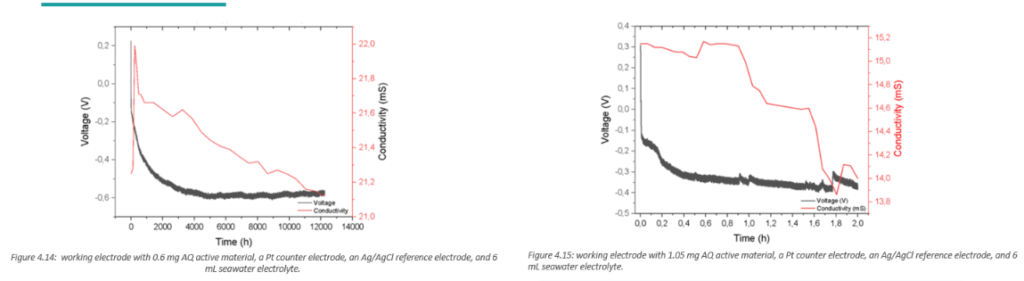
For me, this was one of the most valuable lessons of the project. The purpose of the three-electrode system was never to produce the largest conductivity decrease. Its purpose was to improve the reliability of electrochemical interpretation. In research, obtaining a cleaner and more interpretable signal is often more valuable than simply obtaining a larger one. This transition marked an important shift in our study from demonstrating that the system worked to understanding why it behaved the way it did.
Looking Beyond Conductivity: What This Project Taught Me
At the beginning of this project, I thought the main challenge would be developing an electrode capable of reducing the conductivity of seawater. Looking back, I realize that this was only a small part of the story.
One of the biggest lessons I learned is that experimental results are only as meaningful as the methodology used to obtain them. A conductivity decrease, by itself, is simply a measurement. Understanding why that decrease occurs requires carefully designed control experiments, appropriate electrochemical configurations, and a clear awareness of the limitations of each measurement technique.
This perspective shaped nearly every stage of our work. Before interpreting conductivity changes, we first confirmed that the AQ-based electrode remained electrochemically active in natural seawater. We then investigated whether passive contact between the electrode material and seawater could produce similar effects without applying electricity. Finally, we transitioned from a two-electrode configuration to a three-electrode system to improve the reliability of electrochemical interpretation. Each experiment answered a different question, and together they formed a coherent methodology rather than a collection of isolated measurements.
Another important lesson was the value of acknowledging experimental limitations. Throughout this study, conductivity was intentionally treated as a semi-quantitative indicator rather than direct evidence of absolute salt removal. Without ion-specific analytical techniques such as ICP or ion chromatography, conductivity-derived values should be interpreted with appropriate scientific caution. Rather than weakening the study, explicitly recognizing these limitations strengthens the credibility of the conclusions and helps define meaningful directions for future research.
For me, this project was ultimately about much more than desalination batteries. It was my first opportunity to experience how engineering research actually develops—starting with a question, challenging initial assumptions, refining experimental methods, and learning that reliable interpretation often matters more than obtaining the largest numerical result.
Final Thoughts
When I first started working on this project, I was mainly interested in learning more about battery materials. I expected to spend most of my time focusing on electrodes, electrochemical measurements, and laboratory experiments. While all of these became important parts of the project, I soon realized that the most valuable lessons extended far beyond the materials themselves.
This project introduced me to the interdisciplinary nature of desalination batteries, where electrochemistry, materials science, and water treatment converge within a single research problem. More importantly, it showed me that successful engineering research is rarely about obtaining a single impressive result. Instead, it is about asking meaningful questions, designing experiments that answer those questions, and interpreting the results with appropriate scientific caution.
Although our work focused specifically on anthraquinone-based electrodes in natural seawater, the broader motivation reaches much further. As freshwater scarcity and global energy demand continue to grow, electrochemical desalination technologies are likely to remain an active area of research. Desalination batteries represent only one possible approach, but they illustrate how combining ideas from different engineering disciplines can inspire entirely new technological solutions.
Like any research project, this study also has its limitations. The conductivity measurements presented throughout the project provide valuable insight into the electrochemical behavior of the system, but they should not be interpreted as direct measurements of absolute salt removal. Future studies incorporating ion-specific analytical techniques and further optimization of electrode materials and cell configurations will undoubtedly provide a deeper understanding of these systems.
Looking back, I see this graduation project not as the conclusion of my undergraduate education, but as the beginning of a much longer journey into battery research. It strengthened my interest in electrochemical energy storage, introduced me to the fascinating field of desalination batteries, and reminded me that every experiment—whether successful or not—offers an opportunity to learn something new.
I hope this article has provided not only an introduction to desalination batteries, but also a glimpse into how an engineering research project evolves from an initial question to a structured experimental investigation. If it encourages even one student to become curious about electrochemistry, battery research, or water treatment technologies, then it has already achieved far more than simply summarizing my graduation project.


1 yorum