🏭 From Formulation to Manufacturing: What My Production Internship at Hayat Kimya Taught Me as a Chemical Engineer
✍️ Read this before…
This blog is primarily based on my production internship at Hayat Kimya and on the internship logbook that I prepared during this period as part of the Chemical Engineering internship requirements at Gebze Technical University.
Throughout this blog, many of the engineering figures, conceptual diagrams, and process illustrations are reproduced or adapted from my own internship logbook, where they were originally created to explain general chemical engineering concepts and manufacturing principles.
To respect industrial confidentiality, this article intentionally avoids sharing proprietary formulations, company-specific operating parameters, production recipes, internal quality criteria, or any confidential manufacturing information. Instead, it focuses on publicly explainable engineering principles and on the professional perspective I developed during my internship.
My objective is not to explain how a particular company manufactures its products, but rather to share how this experience transformed my understanding of chemical engineering and industrial manufacturing.
🏭 From Formulation to Manufacturing
What My Production Internship at Hayat Kimya Taught Me as a Chemical Engineer
Reflections on formulation engineering, industrial manufacturing, automation, quality systems, and the transition from laboratory research to manufacturing thinking.
Throughout my undergraduate studies in Chemical Engineering at Gebze Technical University, I intentionally shaped almost every academic experience around one long-term goal:
Building a career in battery technologies.
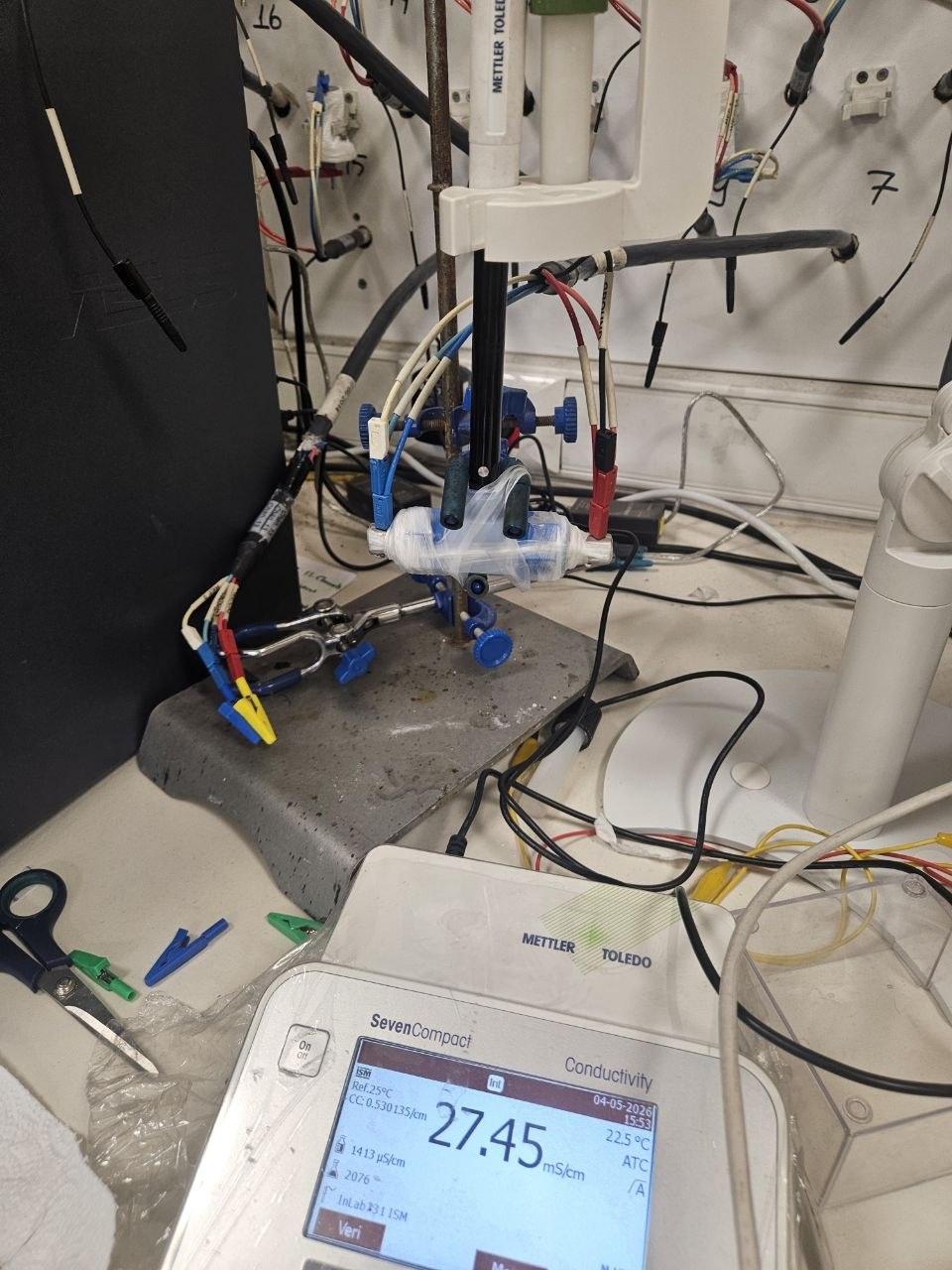
From joining the university’s battery laboratory as a volunteer during my first year to working on sodium-ion battery materials within a TÜBİTAK research project, completing my bachelor’s thesis on battery-inspired desalination systems, and later conducting electrochemical research at the Ångström Advanced Battery Centre of Uppsala University, most of my education revolved around laboratory-scale research.
My everyday questions usually sounded like this:
🔋 Can this material store more energy?
⚡ Why does this electrochemical reaction occur?
📊 What does the impedance spectrum reveal?
🔬 Which mechanism limits the performance?
These are typical research questions.
But chemical engineering is much broader than laboratory research.
At some point during my undergraduate education, I realized that another set of questions was missing from my perspective.
Questions such as:
🏭 Can this product actually be manufactured?
⚙️ Can the same quality be reproduced every day?
📦 Can the production process remain stable?
🔄 What happens when laboratory-scale experiments become industrial-scale production?
🦺 How do engineers maintain safety while producing thousands of kilograms every day?
These questions are rarely answered inside university laboratories.
They are answered inside factories.
That realization became one of the main reasons I decided to complete my production internship at Hayat Kimya, one of Türkiye’s leading manufacturers in the fast-moving consumer goods (FMCG) industry.
Initially, this internship might appear unrelated to my long-term goal of working in battery technologies.
However, I viewed it differently.
Rather than considering detergent manufacturing as a completely different field, I saw it as an opportunity to understand something that exists in every branch of chemical engineering:
How laboratory knowledge becomes industrial manufacturing.
This article is therefore not simply a summary of my internship.
It is a reflection on how spending four weeks inside a large-scale production facility fundamentally changed the way I understand chemical engineering.
💡 Key Reflection
Research teaches why materials work. Manufacturing teaches whether those materials can actually become products.
This single sentence summarizes the motivation behind my entire internship.
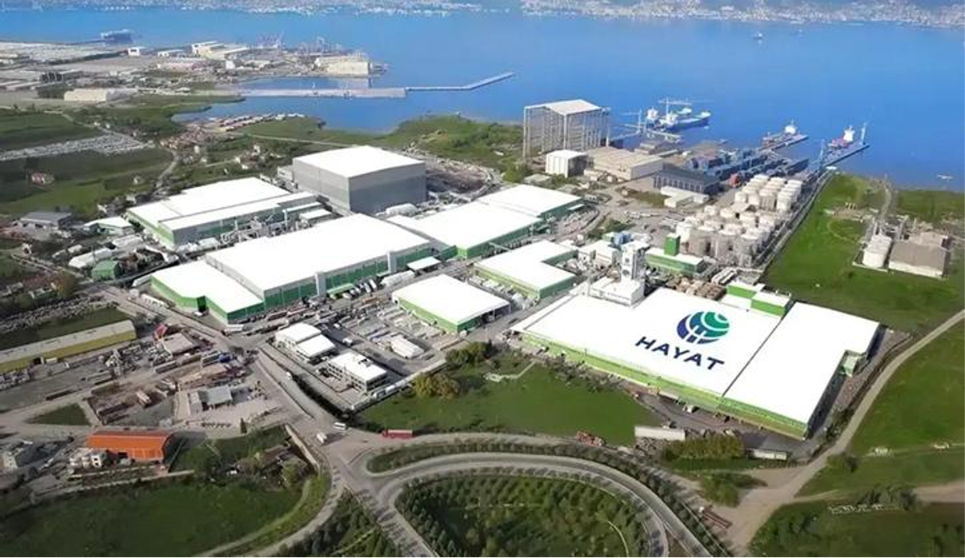
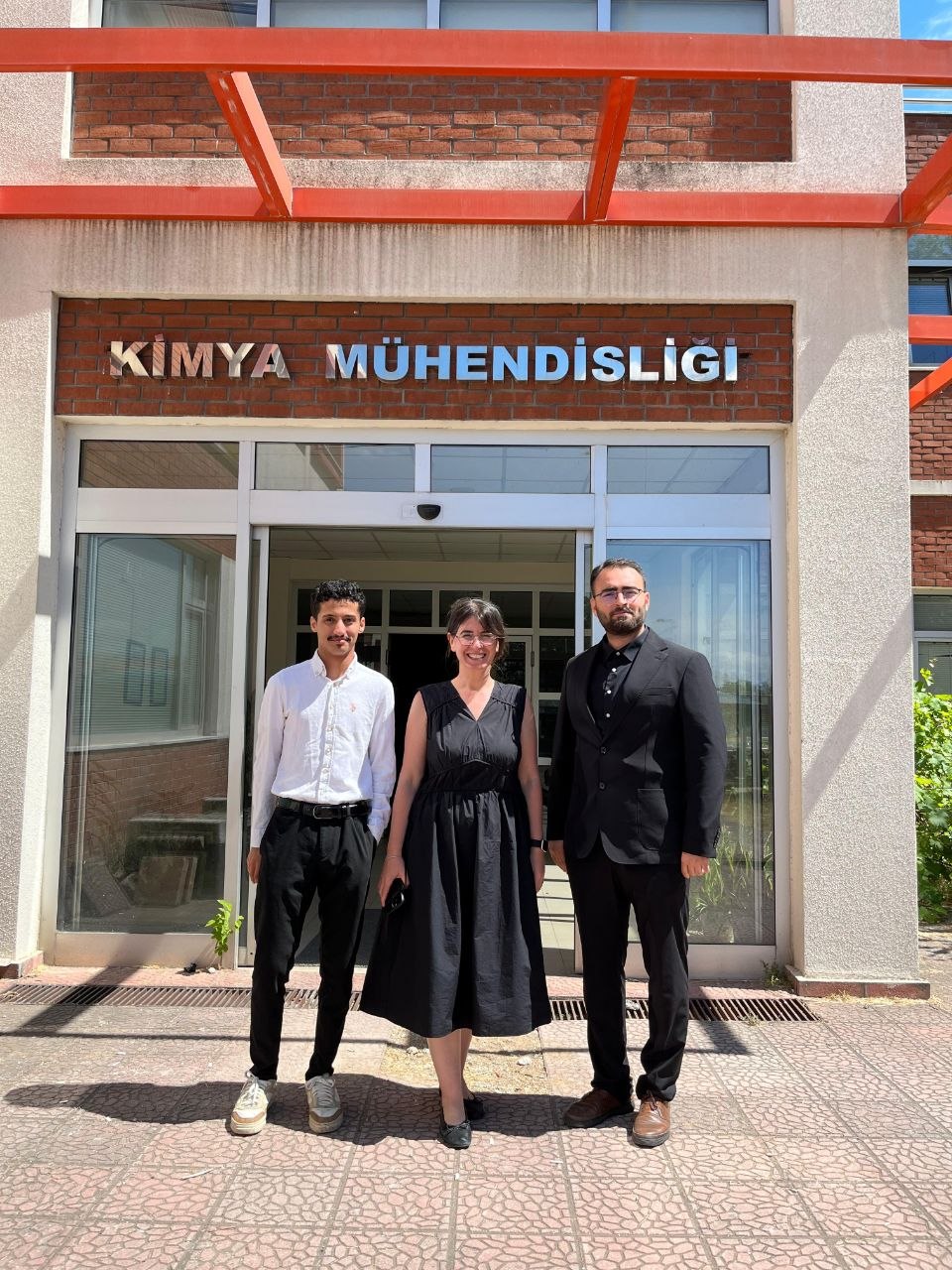
Production Internship at Hayat Kimya, Kocaeli Manufacturing Facility (January–February 2026).
🏭 Seeing a Factory as an Integrated Chemical Engineering System
Before starting my internship, I unconsciously imagined a chemical factory as a collection of machines.
Storage tanks…
Mixers…
Pumps…
Pipelines…
Heat exchangers…
Packaging lines…
Everything appeared to be an independent piece of equipment performing its own task.
Once I entered the production environment, that perception changed almost immediately.
I realized that a modern manufacturing facility cannot be understood by looking at its equipment individually.
Instead,
it must be understood as an integrated engineering system.
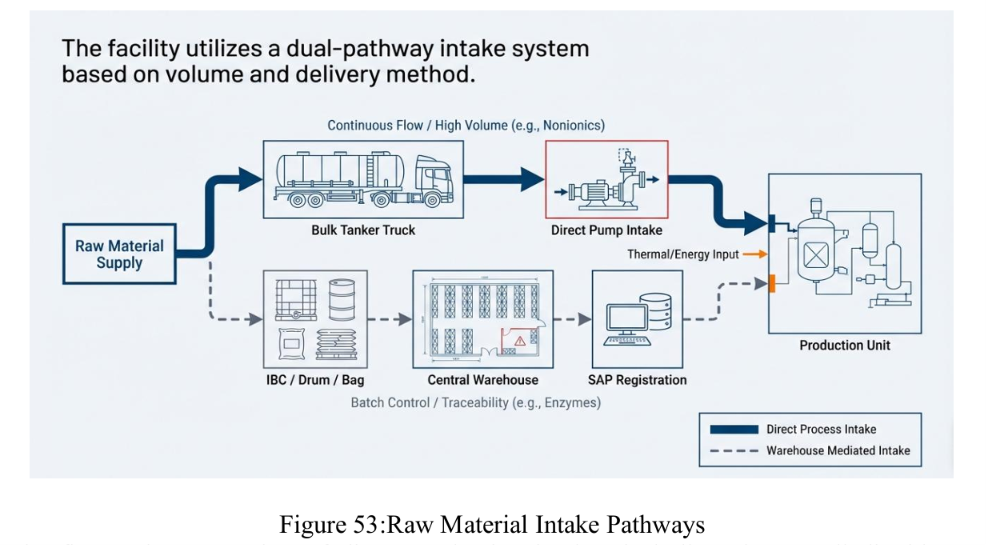
🔗 Production Begins Long Before the Mixer Starts
One of my earliest observations was that production does not begin when raw materials enter a mixing vessel.
Production actually starts much earlier.
Long before any operator presses the start button, numerous engineering activities have already taken place.
For example,
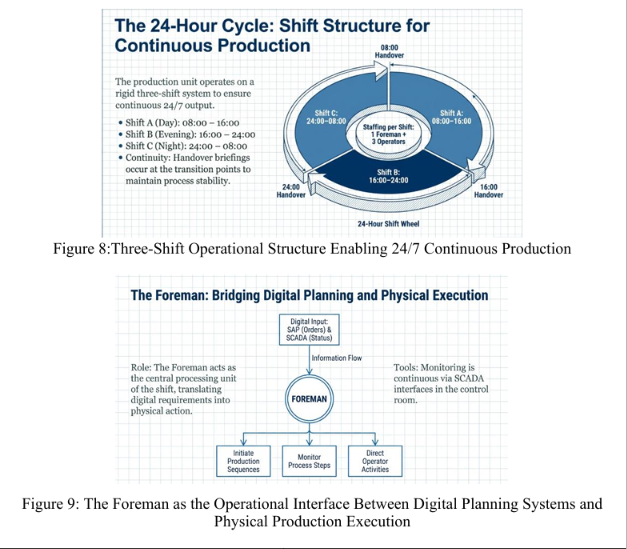
📋 Production planning has already generated the production order.
📦 Raw materials have been procured and verified.
🏷️ Every incoming material has been assigned its traceability information.
⚙️ Equipment readiness has been confirmed.
🧪 Quality specifications have already been determined.
📅 Packaging operations have been synchronized.
Only after all of these conditions are satisfied can physical manufacturing begin.
This observation fundamentally changed how I perceived chemical production.
Instead of viewing manufacturing as a sequence of chemical operations, I began to see it as the coordination of materials, information, people, and engineering decisions.
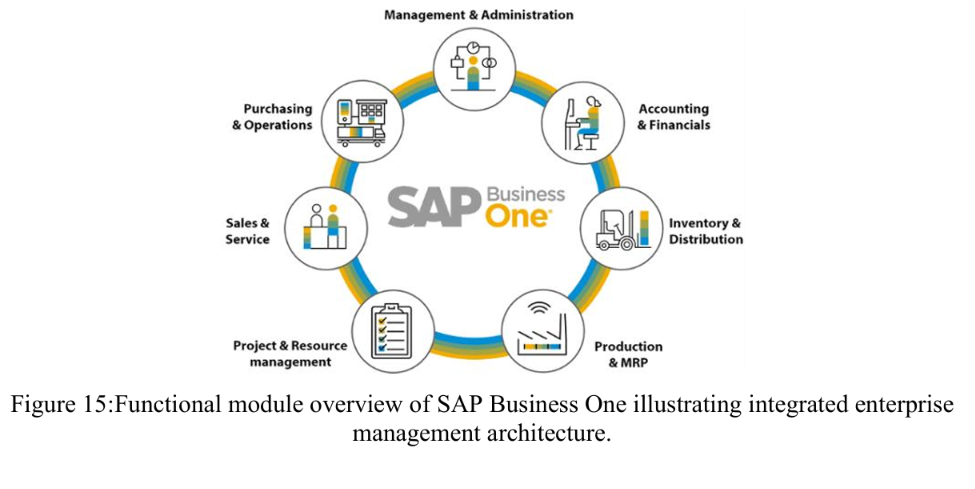
🏭 A Factory Is More Than Production Equipment
Another important realization was that the mixer itself represents only one small part of the manufacturing process.
Behind every production batch lies an entire ecosystem working simultaneously.
During my internship, I observed interactions between:
🛢️ Raw material storage
🔄 Material transfer systems
🌀 Mixing operations
🌡️ Utility systems
🧪 Quality laboratories
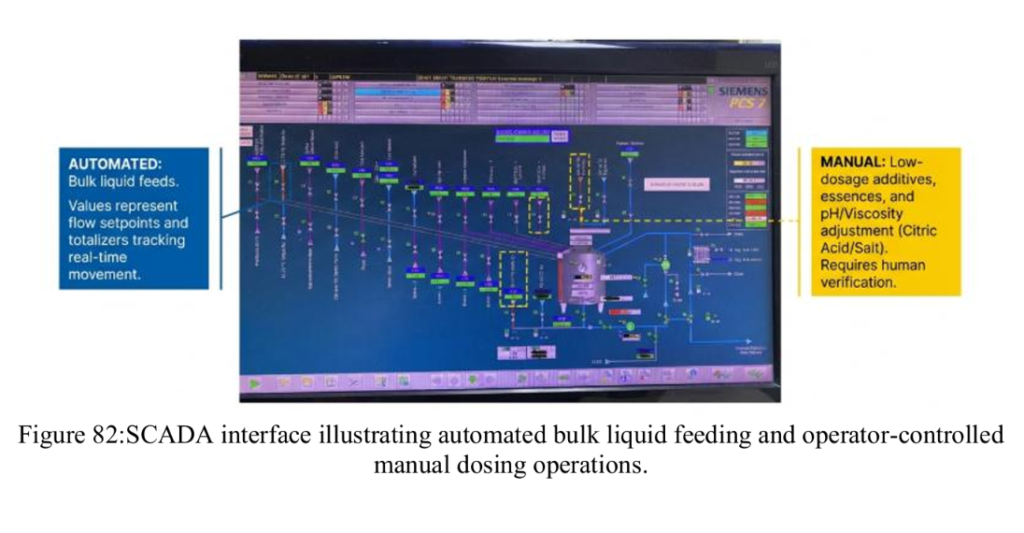
💻 Digital automation
📦 Packaging
🚚 Warehousing
📊 Production planning
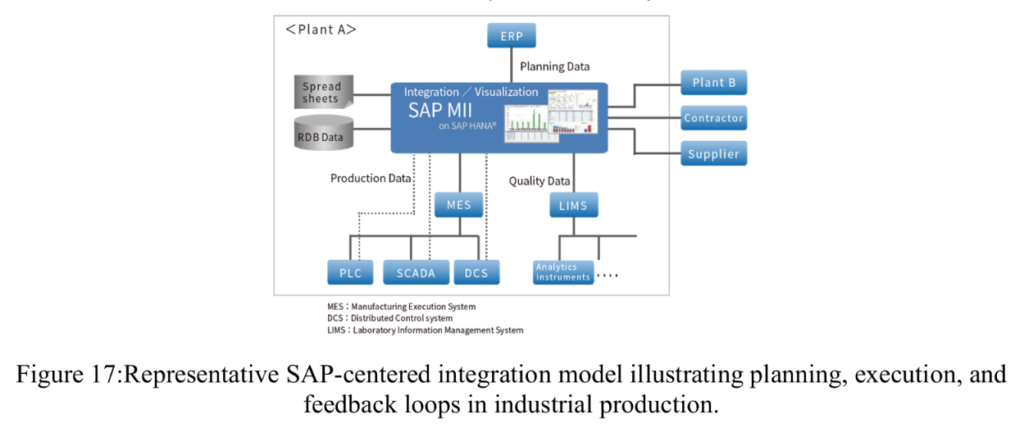
Although these departments appear independent, they continuously exchange information and depend on one another.
This was one of the first times I truly appreciated that industrial manufacturing is fundamentally an exercise in systems integration.
🔁 Manufacturing Is Full of Feedback Loops
At university, production processes are often presented as linear flow diagrams.
Input.
↓
Process.
↓
Output.
Industrial manufacturing rarely behaves this way.
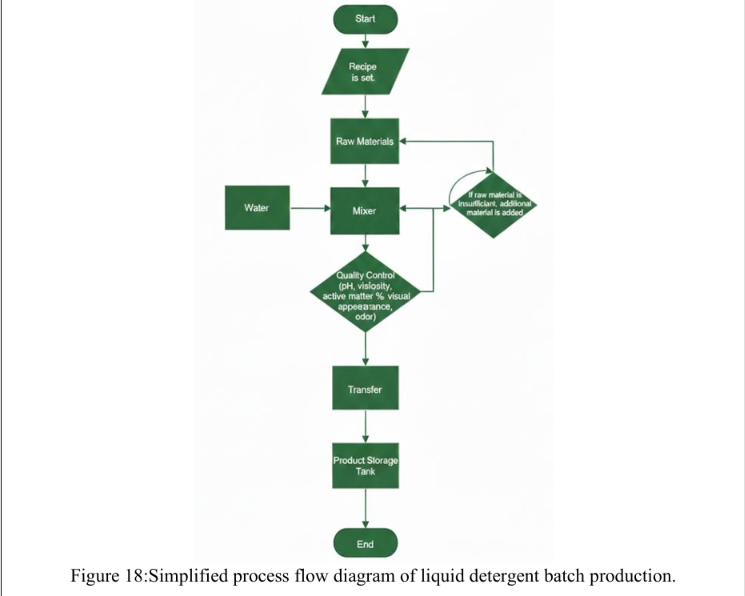
Instead, production continuously evaluates itself.
If viscosity deviates…
the formulation may require adjustment.
If pH falls outside specifications…
engineers investigate before continuing.
If packaging materials are delayed…
production planning changes.
If raw materials are unavailable…
the production sequence may be reorganized.
Production therefore follows a much more realistic cycle:
Once I recognized this pattern, I stopped viewing manufacturing as a fixed sequence of operations.
Instead,
I started seeing it as a continuous decision-making process.
📊 Planning and Reality Are Never Identical
One of the most interesting engineering lessons I observed involved production planning.
At first glance, production schedules appear highly organized.
Everything seems predetermined.
However, reality is far more dynamic.
Production engineers continuously adapt to:
📦 Raw-material availability
🚚 Delivery schedules
📅 Packaging priorities
⚙️ Equipment conditions
🧪 Quality feedback
👥 Communication between departments
This experience taught me something that no textbook had ever emphasized.
A production plan describes what should happen. Engineering judgment determines what can actually happen.
🎓 Where University Courses Finally Connected
Before this internship, every chemical engineering course seemed to belong to its own world.
Fluid Mechanics.
Heat Transfer.
Mass Transfer.
Instrumentation.
Process Control.
Chemical Technology.
Each subject appeared separately in my education.
Inside the factory, those boundaries disappeared.
A single production decision could simultaneously involve:
🌊 Fluid Mechanics
🔥 Heat Transfer
⚙️ Mechanical Design
📊 Instrumentation
🧪 Material Properties
🦺 Process Safety
📦 Production Planning
Suddenly, chemical engineering no longer looked like seven different university courses.
It became one coherent engineering language.
💡 Key Reflection
Chemical engineering is not the study of individual unit operations. It is the discipline of understanding how all of them interact inside one industrial system.
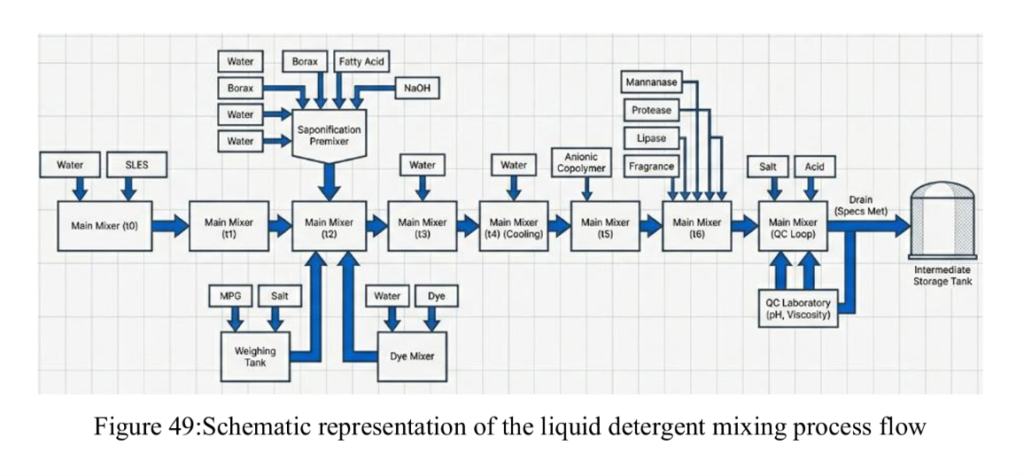
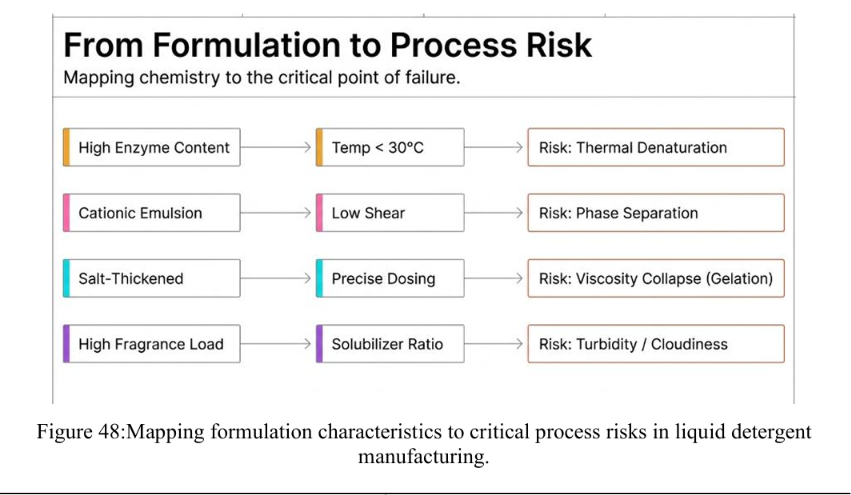
🧪 Detergent Manufacturing Is More Than Mixing Chemicals
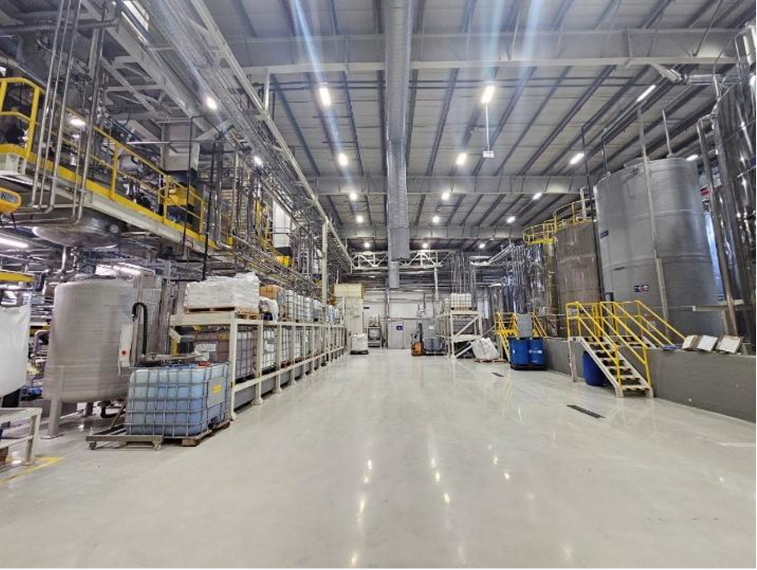
When I first entered the liquid detergent production facility, I assumed that manufacturing a detergent mainly involved adding several chemicals into a mixing vessel and blending them until a homogeneous product was obtained.
That assumption disappeared within the first few days.
One of the earliest technical lessons I learned during my internship was surprisingly simple:
A detergent is not a chemical. It is a carefully engineered formulation.
Although this statement sounds straightforward, it completely changed how I viewed not only detergent production but also industrial chemical manufacturing as a whole.
Unlike many classical chemical processes that focus on synthesizing a single target molecule, detergent manufacturing is fundamentally a formulation engineering problem.
The objective is not to create a new molecule.
The objective is to design an entire system whose components work together consistently.
💡 Key Reflection
Industrial success is often determined not by inventing a new molecule, but by making many different materials behave as one stable product.
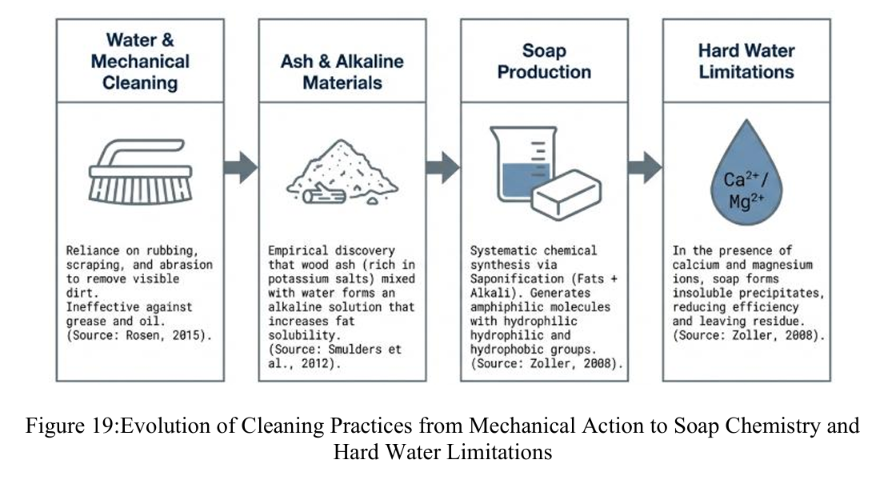
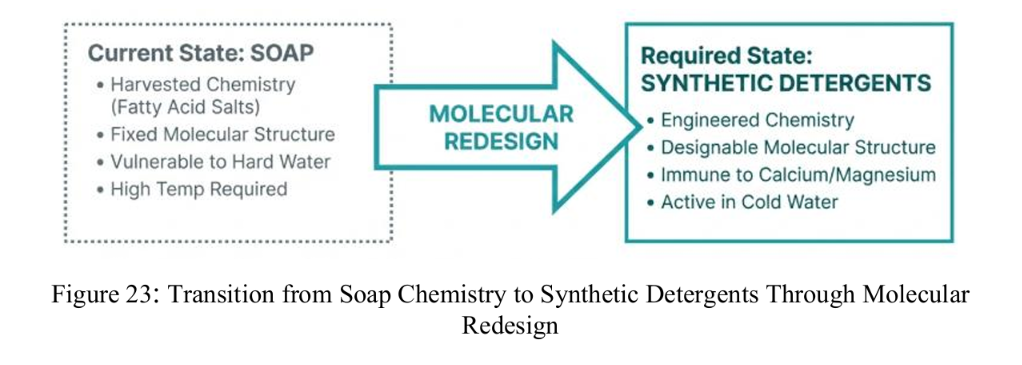
🧼 From Soap to Synthetic Detergents
One of the first technical subjects I studied during my internship was the historical evolution of cleaning products.
Understanding modern detergents first required understanding soap.
Soap represented one of humanity’s earliest chemically engineered cleaning materials.
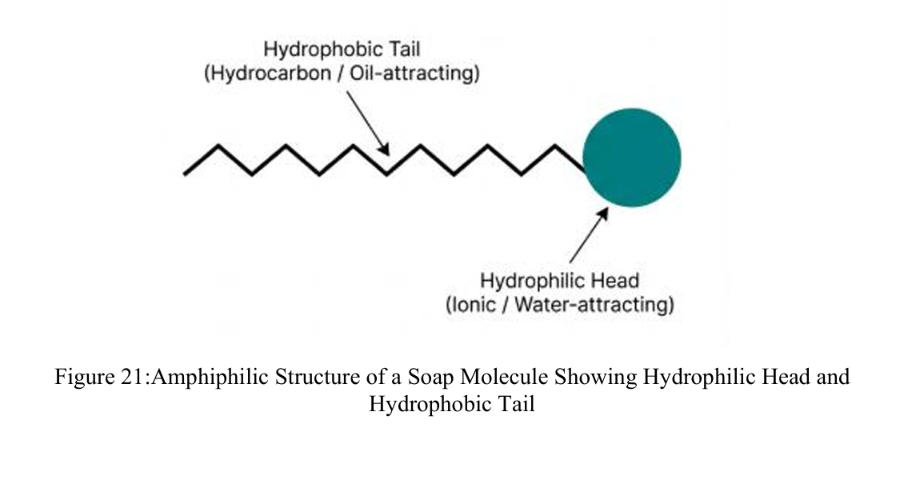
Its molecular structure contains two completely different regions.
💧 A hydrophilic head, which interacts with water.
🛢️ A hydrophobic tail, which interacts with oils and grease.
This dual nature allows soap molecules to organize into micelles, surrounding oily contaminants while remaining dispersed in water.
As a result, substances that normally cannot mix with water become removable during washing.
This simple molecular principle remains one of the most elegant examples of applied chemistry.
⚠️ Every Engineering Solution Has Its Limitations
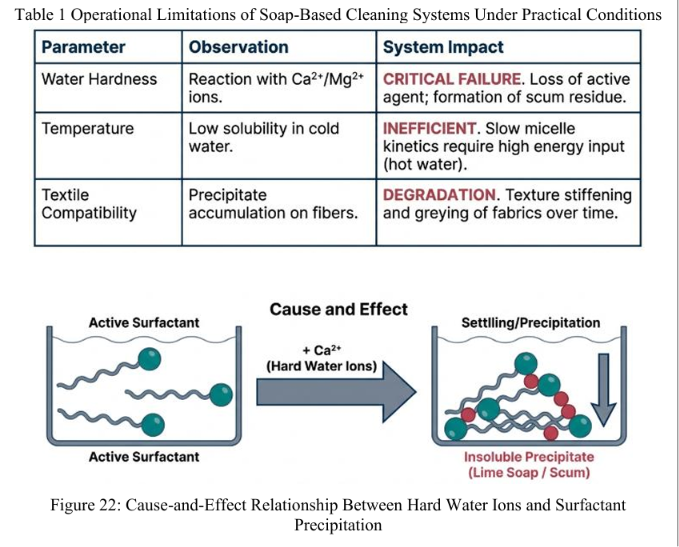
Despite its historical importance, soap is not a perfect cleaning agent.
One of its major weaknesses appears in hard water.
Natural water often contains calcium and magnesium ions.
These ions react with soap molecules to form insoluble precipitates, reducing cleaning efficiency and leaving unwanted deposits on fabrics and surfaces.
From a consumer’s perspective, this means poorer washing performance.
From an engineer’s perspective, however, it represents something more important:
A design limitation.
Once I began thinking like a chemical engineer, I stopped asking:
“Why does soap clean?”
Instead, I started asking:
“Why does soap fail under certain operating conditions?”
That small shift in thinking marks the difference between learning chemistry and practicing engineering.
🔄 Engineering Does Not Replace Problems. It Solves Them.
The limitations of soap eventually led to one of the most significant developments in household chemistry:
the emergence of synthetic detergents.
What fascinated me during my internship was that synthetic detergents were not introduced simply because engineers wanted something “new.”
They were developed because engineers wanted something better suited to real operating conditions.
Synthetic surfactants maintain their cleaning performance across a much wider range of water qualities, temperatures, and washing environments.
In other words,
modern detergents were born from an engineering problem not merely from a chemical discovery.
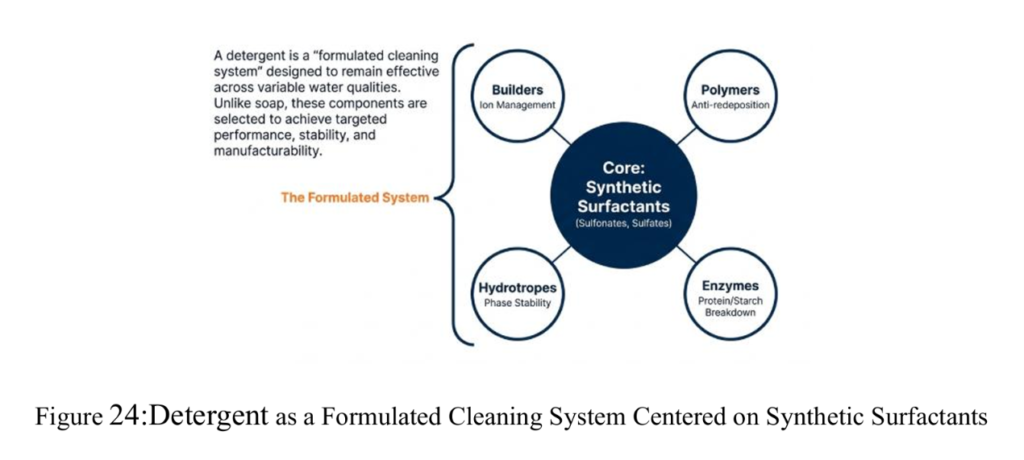
🧩 A Detergent Is a Formulated System
This was probably the most important technical concept I learned during the internship.
Modern detergents are not composed of a single “active ingredient.”
Instead, they consist of numerous functional components, each performing a different engineering role.
A typical formulation may include:
🟦 Surfactants
🟩 Builders
🟨 Enzymes
🟪 Polymers
🟧 Solvents and hydrotropes
🟥 Bleaching systems
🌸 Fragrances
🎨 Colorants
🛡️ Preservatives
Each ingredient contributes something different.
Some improve cleaning.
Others stabilize the formulation.
Some control viscosity.
Others improve storage stability or maintain product appearance.
The final detergent therefore represents the behavior of the complete formulation rather than the behavior of any individual component.
This systems-based description is also how detergent composition is introduced in my internship logbook, where detergents are presented as formulated cleaning systems centered on surfactants together with co-formulants selected for performance, stability, and manufacturability.
⚙️ Formulation Engineering Is About Balance
One of the biggest misconceptions about formulation engineering is assuming that adding more functional ingredients automatically leads to a better product.
Industrial manufacturing taught me otherwise.
A successful formulation is not the one with the greatest number of ingredients.
It is the one in which all components remain compatible throughout manufacturing, storage, transportation, and consumer use.
This means engineers must simultaneously consider:
⚖️ Chemical compatibility
🌡️ Temperature sensitivity
🌀 Mixing behavior
💧 Viscosity
📦 Storage stability
🧪 Product performance
🏭 Manufacturability
The challenge is therefore not simply selecting materials.
The challenge is making them behave as a single, stable engineering system.
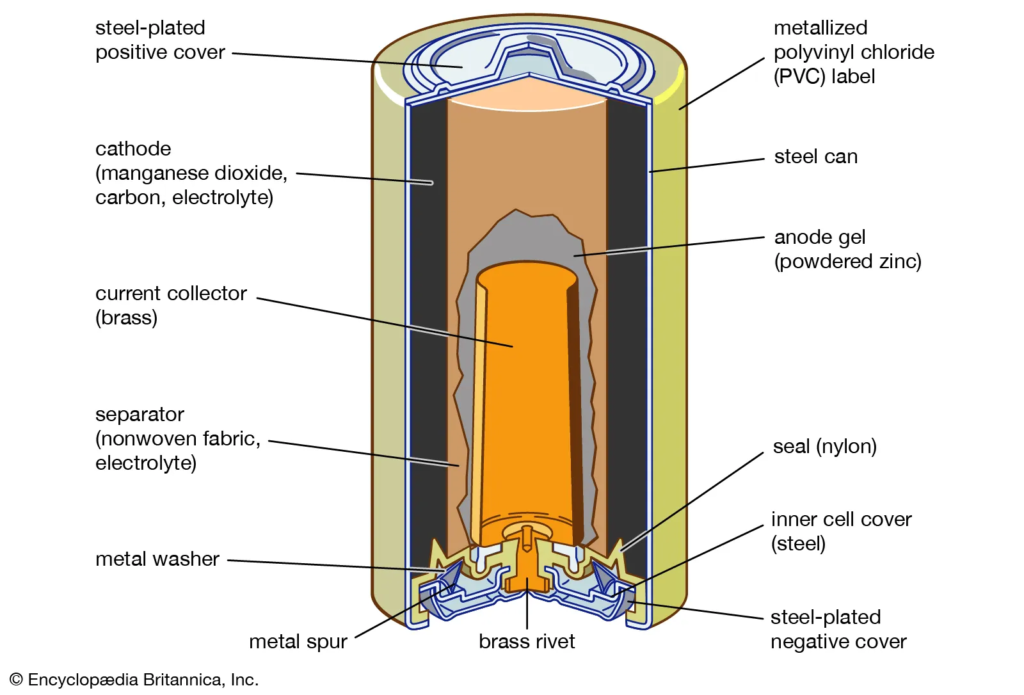
🔋 An Unexpected Connection to Battery Research
Perhaps the most surprising outcome of this section was realizing how familiar this design philosophy already was.
Although detergents and batteries belong to completely different industries, both rely on remarkably similar engineering principles.
In battery research, we rarely optimize a single material in isolation.
Instead, overall performance emerges from the interaction between:
🔋 Active material
⚫ Conductive additive
🧷 Binder
💧 Electrolyte
🔬 Interfaces
⚙️ Processing conditions
A battery electrode, much like a detergent formulation, behaves as a system rather than as an individual material.
This realization was one of the moments when my internship stopped feeling like a temporary experience in the FMCG industry.
Instead, it became directly relevant to my long-term research interests in electrochemical energy storage.
💡 Key Takeaway
Whether designing a detergent or a battery electrode, chemical engineers are ultimately solving the same challenge: making multiple materials function reliably as one integrated system.
🤖 Beyond Machines: Learning How Modern Manufacturing Thinks
When people imagine a chemical factory, they often picture large tanks, complex pipe networks, massive mixers, and countless pumps.
I had a similar image before starting my internship.
However, after spending several weeks inside a production environment, I realized something unexpected.
Factories do not only move chemicals. They also move information.
That single realization completely changed how I perceived industrial manufacturing.
💻 Manufacturing Starts with Information
Every production batch begins with information before it begins with chemistry.
A production order is generated.
Raw materials are verified.
Equipment availability is checked.
Production planning is synchronized.
Packaging schedules are confirmed.
Quality specifications are loaded into the production system.
Only then does manufacturing actually begin.
This means that the first material flowing through a factory is not detergent.
It is information.
🔄 Every Engineering Decision Creates Another
One of the ideas that impressed me most was that manufacturing decisions rarely remain isolated.
Changing one variable often influences many others.
For example,
changing production speed may influence packaging.
Changing viscosity may influence pump performance.
Changing temperature may influence mixing.
Changing raw materials may influence quality control.
Changing production planning may influence warehouse operations.
In other words,
industrial manufacturing behaves much more like an interconnected network than a linear process.
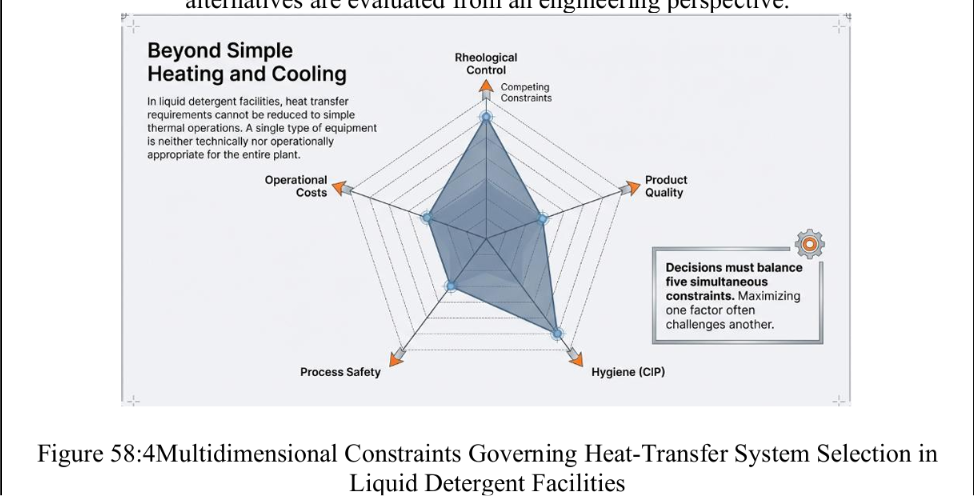
🧠 Engineers Rarely Optimize Only One Variable
Before entering industry, I often associated optimization with laboratory performance.
The objective usually sounded simple:
Increase performance.
Inside manufacturing, optimization became a completely different concept.
Engineers must continuously balance:
⚙️ Product quality
⚡ Energy consumption
🦺 Operational safety
📦 Production capacity
💰 Manufacturing cost
🔁 Process stability
🛠️ Maintenance requirements
📈 Production efficiency
Improving one variable may worsen another.
This means manufacturing is not about maximizing one parameter.
It is about finding the best compromise among many competing objectives.
💡 Key Reflection
Industrial optimization is rarely about achieving the highest possible performance. It is about achieving the most reliable overall performance.
🔥 Why “One Solution” Is Usually the Wrong Solution
Another valuable lesson from the internship was realizing that there is rarely a universal engineering solution.
Initially, I expected to find a single “best” heating system.
A single “best” pump.
A single “best” mixer.
Instead, I observed something very different.
Each engineering solution was selected because it best satisfied the requirements of a particular process.
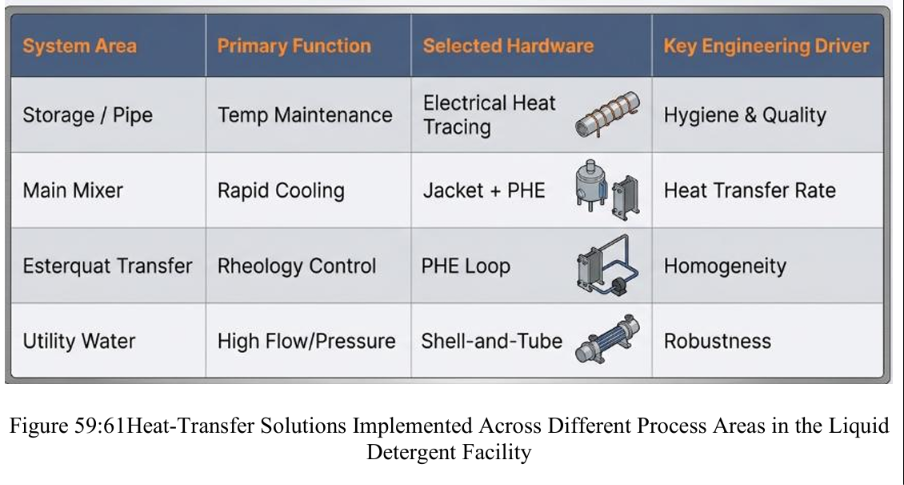
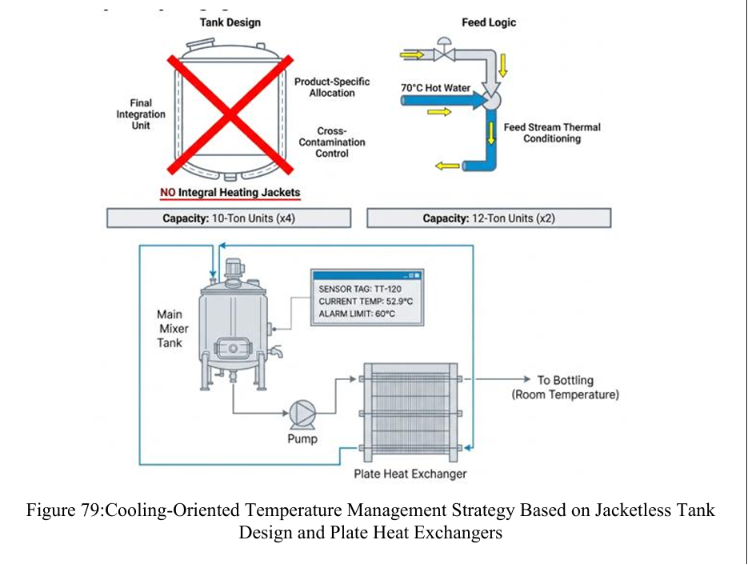
For example, the internship logbook emphasizes that heat-transfer equipment should not be selected according to habit, but according to the specific rheology, hygiene requirements, temperature control needs, energy efficiency, and process constraints of the application.
The same philosophy appeared throughout the production facility.
Engineering was not about standardization.
It was about appropriate selection.
⚙️ Equipment Does Not Define the Process
One of the most important changes in my thinking occurred while observing pumps and material-transfer systems.
Previously, I tended to ask:
Which pump is being used?
During the internship, my question gradually changed into something much more interesting:
Why was this particular pump selected?
That difference may seem small.
In reality, it reflects two completely different engineering mindsets.
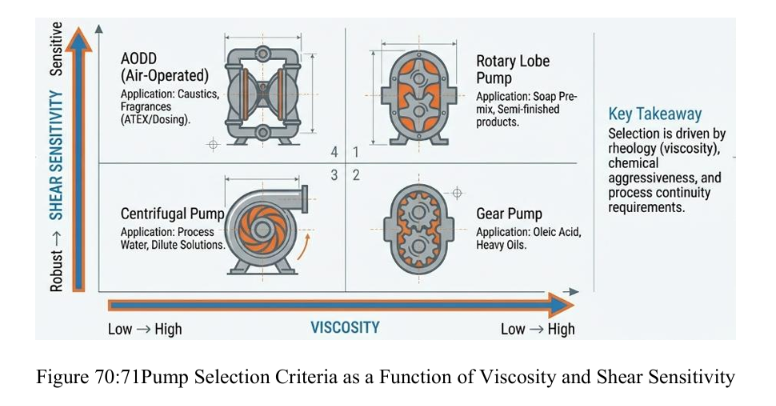
The internship logbook repeatedly emphasizes that pump selection depends on material rheology, viscosity, shear sensitivity, dosing accuracy, chemical compatibility, CIP requirements, automation architecture, and operational safety not simply on flow rate.
The same logic applies far beyond pumps.
A mixer is selected because of formulation behavior.
A heat exchanger is selected because of thermal requirements.
A valve is selected because of process control.
Engineering therefore begins with understanding the process not the equipment.
🧪 Quality Is Not an Inspection Department
Before entering industry, I unconsciously imagined quality control as the final step performed after production had already finished.
The internship completely changed that assumption.
Quality is not something that is added to a finished product.
It is something that is built throughout the entire process.
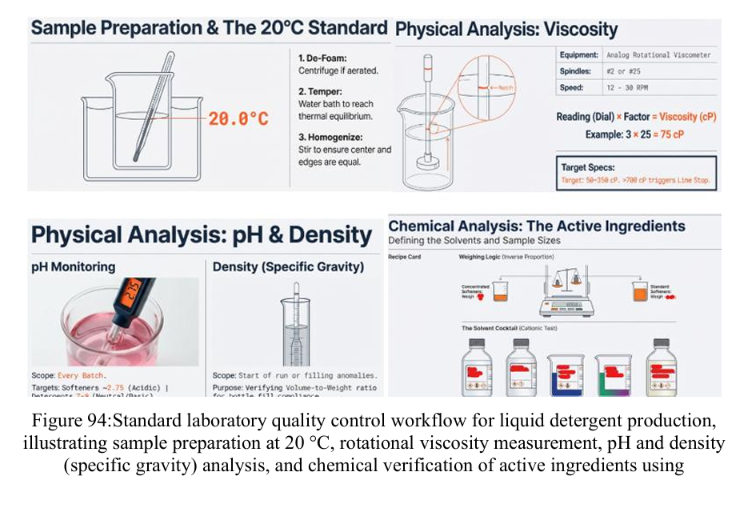
Measurements such as:
🧪 pH
⚖️ Density
🌀 Viscosity
🌡️ Temperature
📊 Process parameters
are not merely recorded.
They continuously guide engineering decisions.
Whenever the process begins to move away from its desired operating window, engineers evaluate the situation and determine whether adjustments are required.
In that sense,
quality is not only an outcome.
It is a continuous feedback mechanism.
🔋 Looking at My Own Research Differently
Perhaps the most lasting effect of this internship appeared only after I returned to battery research.
Previously, I mainly evaluated battery materials through electrochemical performance.
I asked questions such as:
🔋 Does the electrode deliver higher capacity?
⚡ Is the impedance lower?
📈 Does cycling stability improve?
After experiencing industrial manufacturing, additional questions naturally emerged.
🏭 Can this formulation be produced consistently?
🌀 How sensitive is it to mixing conditions?
📦 Would the process remain stable at a larger scale?
🔁 Could another production batch reproduce the same result?
These questions were not directly about detergents.
They were about manufacturing.
And I realized that they would remain relevant regardless of whether I worked on detergents, batteries, polymers, pharmaceuticals, or any other chemical technology.
📈 Manufacturing Is a Constant Optimization Problem
One of the biggest changes in my engineering mindset during this internship was realizing that industrial manufacturing is not about finding the best solution.
It is about finding the best balance.
Before entering industry, I often evaluated engineering problems from a laboratory perspective.
If an experiment produced better performance, lower impedance, higher efficiency, or improved stability, I naturally considered it a better result.
Industrial manufacturing taught me that reality is much more complex.
⚖️ Every Improvement Comes with a Trade-Off
One of the most important lessons I learned was that almost every engineering decision improves one aspect of the process while simultaneously introducing new constraints.
Increasing the mixing speed may improve homogenization.
However, it may also:
⚡ increase energy consumption,
🫧 introduce unwanted air into the formulation,
🔧 increase mechanical wear,
💰 raise operational costs.
Similarly,
raising the process temperature may reduce viscosity and improve material transfer,
but it may also:
🌡️ increase energy demand,
🧪 affect temperature-sensitive ingredients,
📉 reduce product stability,
⚠️ require additional safety considerations.
These examples helped me understand that engineering decisions are rarely isolated.
Every improvement creates a new compromise.
💡 Key Reflection
Engineering is not the search for perfection. It is the search for the best compromise among competing objectives.
🏭 Laboratory Success Does Not Guarantee Manufacturing Success
One realization repeatedly came to my mind during the internship.
In research laboratories, success is often measured by achieving the highest possible performance under carefully controlled conditions.
Industrial manufacturing follows a different philosophy.
A product must not only perform well.
It must also be:
✅ reproducible,
✅ manufacturable,
✅ economically viable,
✅ safe,
✅ scalable,
✅ consistent over time.
This difference fundamentally changed how I evaluate engineering achievements.
A laboratory experiment may produce outstanding results once.
An industrial process must produce reliable results thousands of times.
That is a completely different challenge.
🔄 Reproducibility Became My New Performance Metric
Before this internship, I usually focused on questions such as:
🔋 Can I improve the electrochemical performance?
⚡ Can I reduce internal resistance?
📈 Can I increase capacity?
These questions remain important.
However, another question gradually became equally important:
Can this result be reproduced tomorrow?
Industrial production taught me that reproducibility is not a secondary objective.
It is one of the foundations of engineering.
A remarkable result that cannot be reproduced has very limited industrial value.
A slightly lower-performing process that consistently delivers the same quality may be far more valuable in practice.
🧩 Optimization Is Never One-Dimensional
Perhaps the biggest misconception I had before entering industry was assuming that optimization always means maximizing one variable.
The production environment demonstrated something very different.
Real engineering requires balancing multiple objectives simultaneously.
For example, a production engineer may need to consider:
⚙️ Product quality
⚡ Energy efficiency
🦺 Process safety
💰 Manufacturing cost
📦 Production capacity
🔄 Equipment reliability
🧪 Product stability
👥 Operator safety
📊 Process robustness
Improving one of these objectives may negatively affect another.
Therefore,
optimization becomes a multidimensional engineering problem rather than a simple mathematical exercise.
🧠 The Difference Between a Scientist and an Engineer
This internship also helped me appreciate the subtle distinction between scientific research and engineering practice.
A scientist often asks:
Why does this phenomenon occur?
An engineer usually continues with another question:
How can this phenomenon be transformed into a reliable industrial process?
Neither question is more important than the other.
In fact,
chemical engineering exists precisely because both questions must be answered together.
This realization strengthened my appreciation for the interdisciplinary nature of the profession.
🔋 A Lesson I Took Back to Battery Research
After completing my internship, I noticed that my perspective during battery research had quietly changed.
When preparing electrodes or evaluating electrochemical data, I no longer focused solely on performance.
Instead, additional questions naturally appeared in my mind.
🌀 Is this slurry suitable for large-scale mixing?
🏭 Would this formulation remain stable during manufacturing?
📏 How sensitive is the process to small variations?
🔄 Could another engineer reproduce the same electrode?
📦 Would this procedure still work outside a research laboratory?
These questions had never been central to my thinking before.
The production internship introduced them naturally.
Looking back,
I now realize that I did not simply learn how detergents are manufactured.
I learned how manufacturing influences the way engineers evaluate every chemical system.
🌉 The Unexpected Connection Between FMCG and Battery Technologies
At first glance,
liquid detergents and lithium-ion batteries appear to have almost nothing in common.
One belongs to household chemistry.
The other belongs to electrochemical energy storage.
Yet, during my internship, I began noticing a common engineering philosophy shared by both fields.
Both require:
🧩 carefully designed formulations,
⚙️ well-controlled processing,
📊 continuous quality assurance,
🔄 reproducible manufacturing,
🏭 scalable production,
📈 systematic optimization.
The chemistry may be different.
The engineering mindset is remarkably similar.
That realization transformed what initially seemed like an unrelated internship into an experience directly connected to my long-term career goals.
Understanding how large-scale manufacturing operates in one sector has made me a better researcher in another.
🌍 Looking Back
When I started my production internship at Hayat Kimya, I expected to learn how liquid detergents are manufactured.
I expected to observe mixing tanks.
I expected to understand production lines.
I expected to see pumps, heat exchangers, automation systems, and quality laboratories operating together inside a modern manufacturing facility.
Looking back today,
I realize that these were only the visible parts of the experience.
The real lesson was much deeper.
🧠 Learning How Chemical Engineers Think
Perhaps the greatest outcome of this internship was not the technical knowledge itself.
It was learning a different way of approaching engineering problems.
Before this experience, I often evaluated systems from a research perspective.
Naturally, I concentrated on questions such as:
🔋 Can performance be improved?
⚡ Can efficiency increase?
📈 Can a better material be developed?
Those questions remain fundamental to scientific research.
However, industrial manufacturing introduced another equally important perspective.
Now I also find myself asking:
🏭 Can this process operate continuously?
🔄 Can another engineer reproduce the same result?
📦 Can the product be manufactured consistently?
⚙️ Can quality remain stable over thousands of production batches?
The internship did not replace my research mindset.
It completed it.
⚖️ Applying Chemical Engineering Fundamentals: Mass and Energy Balances
Observing an industrial process is an important part of a production internship.
However, observation alone is not sufficient for chemical engineering.
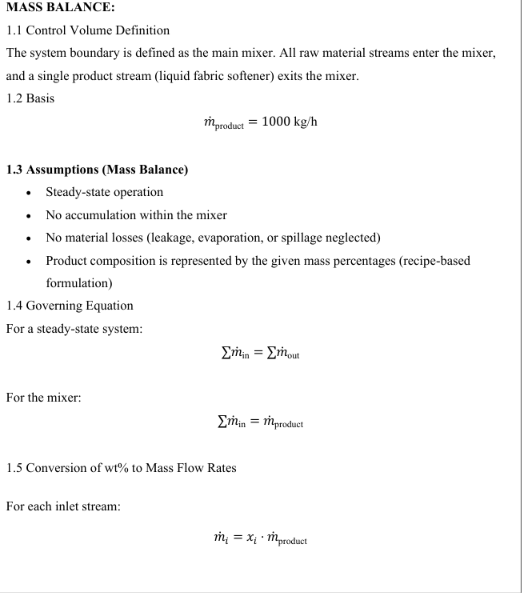
A chemical engineer is also expected to define a process boundary, identify the material and energy streams crossing that boundary, introduce appropriate assumptions, and translate physical operations into a quantitative engineering model.
For this reason, the final two days of my internship were dedicated to one of the most fundamental subjects in chemical engineering:
Mass and energy balances.
These calculations were not included merely as an academic exercise. In chemical engineering education, mass and energy balances form the analytical foundation for understanding whether a process is physically consistent, how materials are distributed, and how much heating or cooling may be required.
They also represent an essential component of production internships because they demonstrate that the student has moved beyond observing equipment and has begun to analyze the process through engineering principles.
Why Mass and Energy Balances Matter
At the most fundamental level, chemical processes must obey two principles:
⚖️ Mass cannot be created or destroyed.
🔥 Energy must be conserved.
These principles appear simple.
Their industrial application, however, requires careful decisions about:
🔲 where the process boundary is drawn, ➡️ which streams enter the system, ⬅️ which streams leave it, 🧪 whether reactions or phase changes occur, 🌡️ how temperature affects enthalpy, 🏭 whether the process operates continuously or in batches, 📊 and which assumptions are reasonable for the analysis.
Mass and energy balances allow engineers to use these questions to:
verify process consistency,
calculate material requirements,
estimate product flow,
determine heating or cooling demand,
compare theoretical predictions with plant observations,
and identify possible sources of deviation.
A process flow diagram shows where materials move. A balance calculation explains what happens to them quantitatively.
🧴 The Case Study: Mixing and Cooling a Fabric-Softener Stream
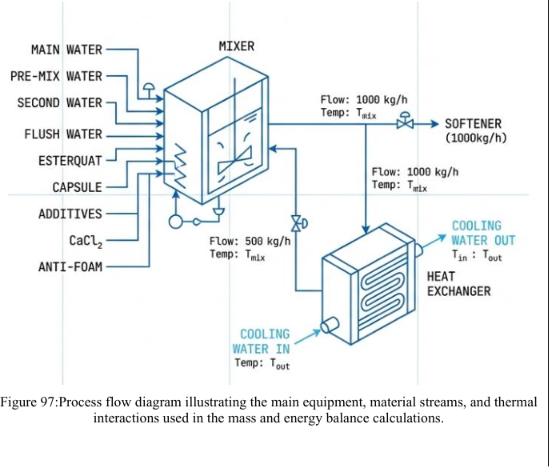
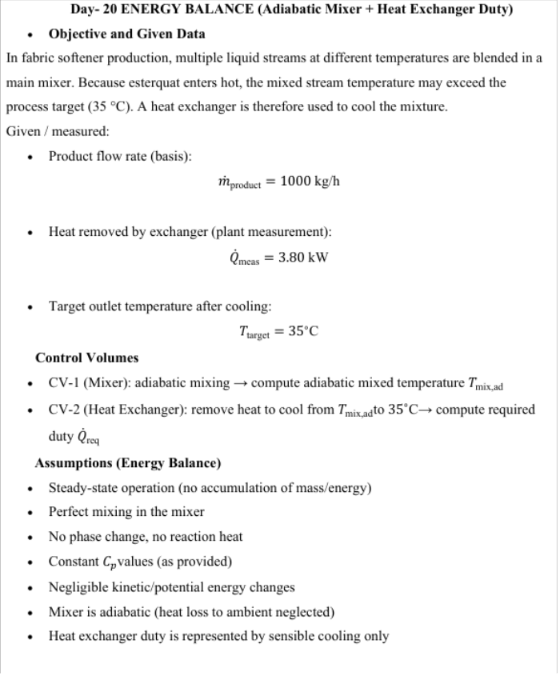
For the final analytical study in my internship logbook, I examined a simplified fabric-softener production case.
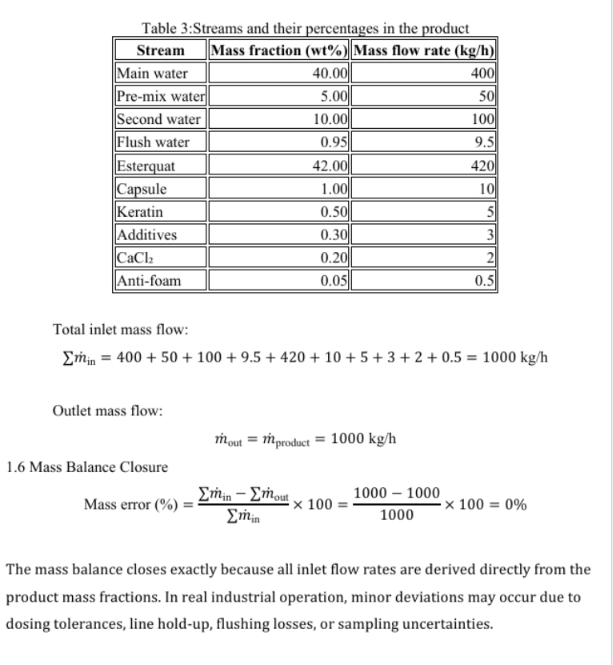
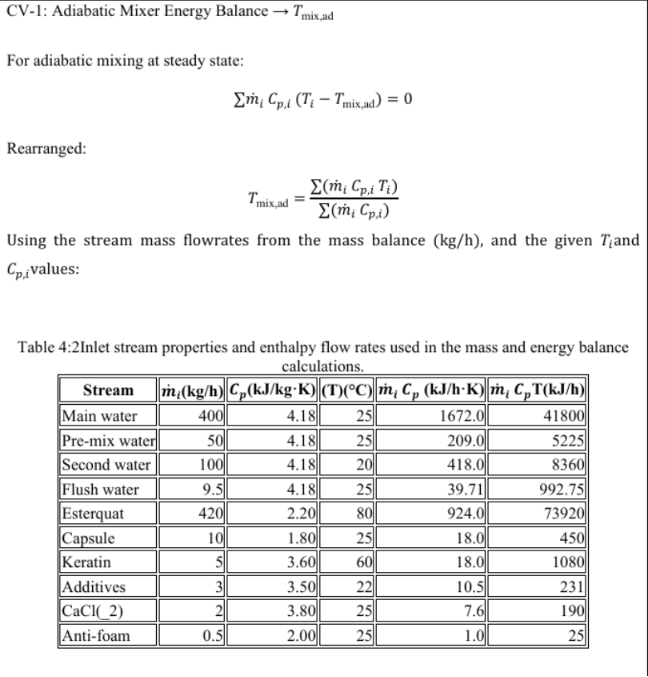
The system included multiple inlet streams entering a main mixer at different flow rates and temperatures. Because one of the major formulation components entered the mixer at an elevated temperature, the mixed product could leave the mixer above the target temperature required for subsequent processing.
The mixed stream was therefore directed to a downstream heat exchanger for cooling.
The study was divided into two connected control volumes:
🔲 Control Volume 1: The Main Mixer
The purpose of the first control volume was to:
⚖️ account for all incoming material streams, 📦 calculate the total product flow, 🌡️ and determine the theoretical mixed-stream temperature under adiabatic conditions.
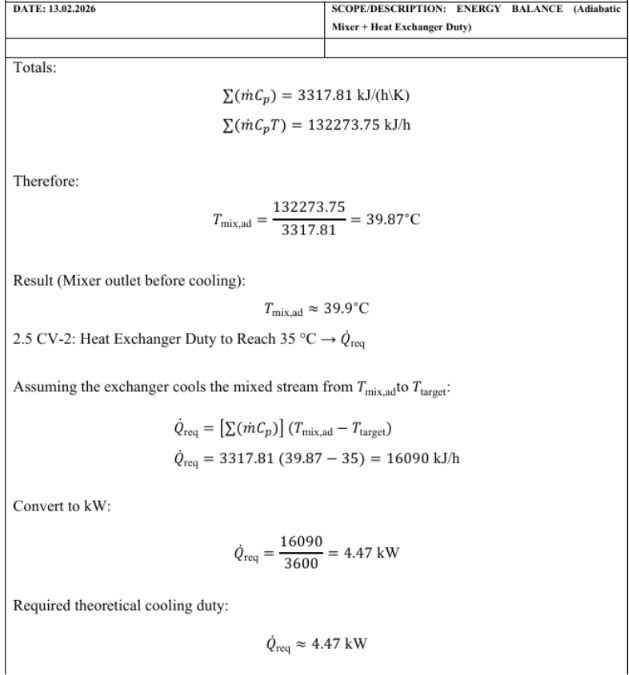
🔲 Control Volume 2: The Heat Exchanger
The purpose of the second control volume was to:
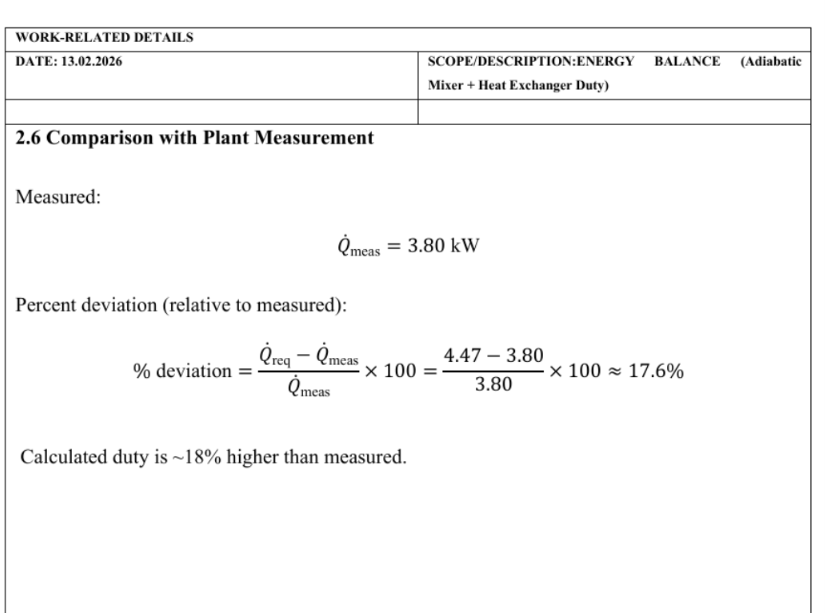
🔥 calculate the heat that had to be removed, 🌡️ reduce the mixed stream to the target outlet temperature, 📊 and compare the theoretical cooling requirement with the measured process value.
The internship logbook therefore treated the mixer and heat exchanger as one connected engineering problem rather than as two isolated pieces of equipment.
🔋 Looking Back at My Own Journey
As I reflected on my undergraduate years, I realized that each major experience had quietly contributed a different layer to my understanding of chemical engineering.
Joining the battery laboratory taught me curiosity.
The TÜBİTAK research project taught me how to investigate scientific problems systematically.
My undergraduate thesis introduced me to designing and evaluating electrochemical systems.
My research internship at the Ångström Advanced Battery Centre strengthened my experimental skills and exposed me to an international research environment.
The production internship at Hayat Kimya added something entirely different.
It introduced me to the world of industrial manufacturing.
Instead of asking only whether a material performs well,
I began asking whether it could eventually become a reliable industrial product.
Looking back,
I no longer see these experiences as independent stages.
They now appear as different pieces of the same puzzle.
Each one prepared me for the next.
Each one expanded my perspective beyond the previous one.
🌉 Research and Manufacturing Are Not Opposites
Before this internship, I unconsciously viewed research laboratories and manufacturing plants as two separate worlds.
Today, I see them differently.
Research generates knowledge.
Manufacturing transforms knowledge into products.
One explains why something works.
The other ensures that it works every single day, under real operating conditions, at industrial scale.
Neither is complete without the other.
Chemical engineering exists precisely at the intersection of these two worlds.
💡 A Lesson I Will Carry Forward
Although my future career will continue in battery technologies,
I know that the lessons I learned during this internship will remain relevant regardless of the specific industry I work in.
Whether developing batteries,
designing electrochemical reactors,
working on energy-storage systems,
or contributing to large-scale manufacturing,
the same engineering principles will continue to guide my decisions.
Systems thinking.
Process understanding.
Reproducibility.
Quality.
Optimization.
Scalability.
These are not concepts limited to detergent production.
They are universal principles of chemical engineering.
🚀 Looking Toward the Future
In the coming years, I hope to contribute to battery manufacturing technologies, particularly in the areas of electrochemical materials, process development, and industrial-scale energy storage systems.
As battery technologies continue moving from laboratory innovation toward gigafactory-scale production, I believe that understanding both research and manufacturing will become increasingly valuable.
Looking back,
I now realize that this internship was never a detour from my battery journey.
It was one of the bridges that connected laboratory science with industrial reality.
💬 Final Reflection
When I started this internship, I wanted to learn how detergents are manufactured.
When I finished it, I realized I had learned something much broader.

1 yorum