
Designing an Ethylene Oxide Plant: My Toughest Challenge in Chemical Engineering
When I started the Chemical Process Design (CED 342) course at Gebze Technical University, I knew it would be different from anything I had done before. This was not just another class, it was a semester-long journey of building a factory on paper. Together with a team of five, and as the group leader, I carried the responsibility of turning a chemical into a full-scale industrial process.
Out of many options, I chose Ethylene Oxide (EO). This was not a random pick: EO is the direct precursor of Polyethylene Oxide (PEO), a polymer electrolyte I had previously studied in connection with solid-state batteries. Choosing EO allowed me to bridge my battery-oriented vision with one of the most demanding courses in our curriculum.
Throughout the semester, I often felt like a startup founder rather than just a student. Every week we had to deliver hundreds of pages of reports, present updates, and make tough technical and managerial decisions. Planning, researching, calculating, managing the team, keeping motivation alive—it was a full package. By the end, we had produced a 300+ page final report and a comprehensive presentation, essentially simulating the setup of a real EO production plant.
Project Scope
The Process Design course was structured almost like a bootcamp: every week, we had to submit detailed reports, present our progress, and steadily build towards a complete industrial design. Each weekly report was around 200 pages, and by the end of the semester, our final deliverable had grown into a 300–400 page document that contained everything from market analysis to reactor sizing.
Our project began with gathering general information about Ethylene Oxide, its properties, hazards, and uses in industries ranging from polymers and detergents to medical sterilization. We then analyzed its global and Turkish market presence, noting that Europe and Asia dominate production while Turkey’s EO capacity remains limited.
After this, we had to make a crucial decision: which production route to choose. While the chlorohydrin process was historically important, we opted for the direct oxidation of ethylene (air or pure O₂), as it reflects modern industrial practice and better sustainability.
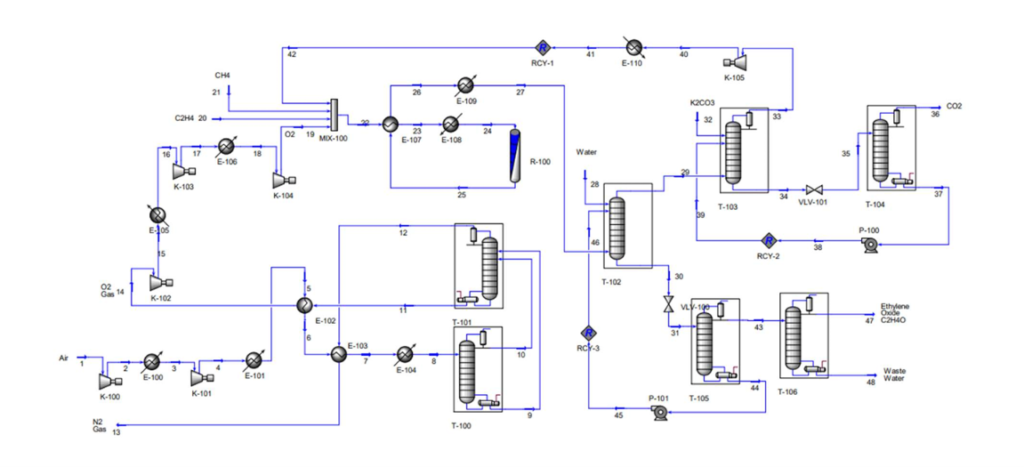
From there, the technical challenge intensified. We designed process flow diagrams in Unisim software, performed material and energy balances, and moved on to equipment design, reactors, heat exchangers, distillation columns, absorbers, strippers, pumps, and compressors. This project required us to apply nearly all the fundamentals of chemical engineering: thermodynamics, fluid mechanics, heat transfer, mass transfer, and separation processes. It was the closest experience to running a real plant without leaving the classroom.

Leading this project was unlike any group work I had done before. Our team consisted of five members, but as the designated team leader, the responsibility to keep everything moving forward was on my shoulders. Every week brought new technical hurdles, balances, simulations, equipment design but equally important were the human challenges: managing deadlines, motivating teammates, resolving conflicts, and keeping everyone aligned.

There were moments when I felt as if I was carrying the entire process almost alone, balancing both the engineering side and the leadership side. It was not just about drawing flow diagrams or calculating reactor sizes, it was about decision-making, planning, and emotional management.
This experience made me realize that a chemical engineer is not only a problem-solver in equations, but also a leader in complex projects, much like a startup founder who has to wear multiple hats at once. For me, this project was as much about personal growth as it was about technical mastery.
Results & Deliverables
Our semester-long work was structured week by week, with each step adding a new layer to the design. By the end, this process had expanded into a 300–400 page final report and a full presentation. Here is how the journey unfolded:
- Week 1 – Project Selection
We chose Ethylene Oxide (EO) among several alternatives, linking it strategically to my earlier focus on polymer electrolytes and batteries. - Week 2 – General Information
We researched EO’s physical, chemical, and toxic properties, its reactions, occurrence, and production methods. - Week 3 – Global & Turkish Market Situation
We studied the largest producers worldwide, plant capacities, trade values, imports, and exports. We also examined Turkey’s production scale and its commercial limitations. - Week 4 – Process Selection & Capacity
We compared production technologies (chlorohydrin vs direct oxidation), presented flow diagrams, and explained why we selected direct oxidation for our design. - Week 5 – Block Flow Diagrams
We created block flow diagrams, listed the required equipment, defined feedstocks and products, analyzed by-products, and discussed economic evaluations. - Week 6 – Process Flow Diagrams (Unisim)
We built full process flow diagrams in Unisim, including equipment and stream specifications. - Week 7 – Material & Energy Balances
We calculated complete balances to ensure realistic industrial-scale flows. - Week 8 – Equipment Design
Finally, we designed major process equipment: reactors, vessels, heat exchangers, distillation columns, absorbers, strippers, pumps, and compressors.
This structured, week-by-week progression forced us to apply nearly every principle of chemical engineering,thermodynamics, mass transfer, heat transfer, fluid mechanics, and separation processes. It was the closest I’ve come to designing a real plant.
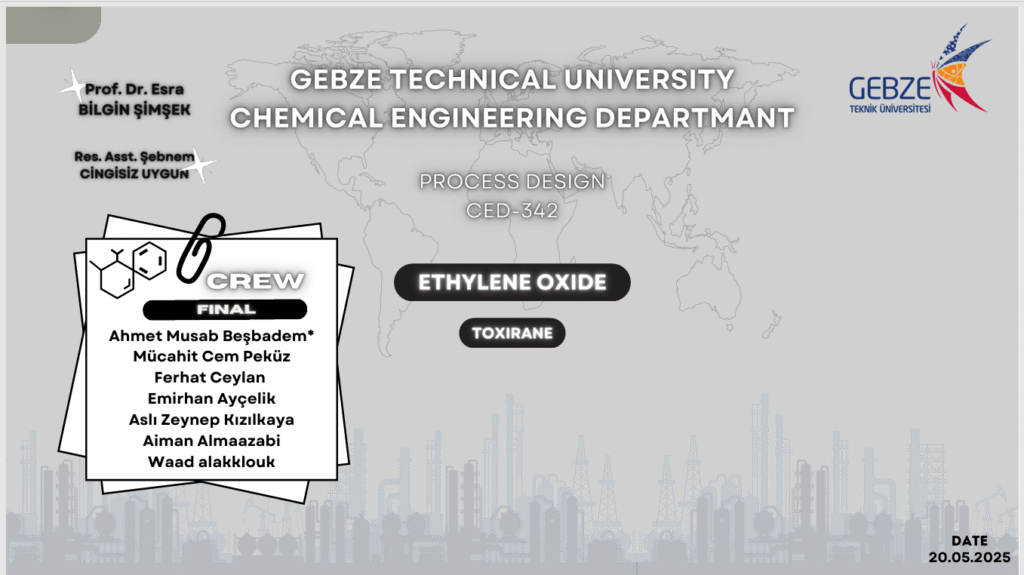
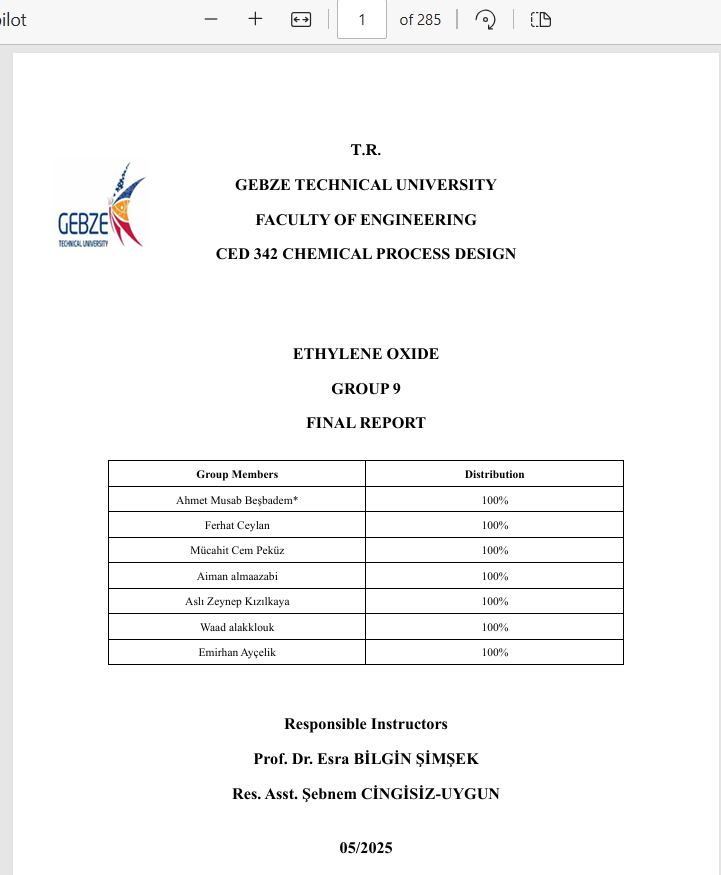
Below are two snapshots from our work: one taken from our final presentation, and another from our comprehensive final report. They reflect the scale and depth of what we produced during the semester.
For those who would like to dive deeper, we have uploaded both the full final report (300+ pages) and the final presentation file to a shared Google Drive folder. You can access them here:
📂 [EO Production Project – Final Report & Presentation (Google Drive)](https://drive.google.com/drive/folders/17S8ZE8d7P8O5E7mcZj4d4Oo0tHx9WsFM)
2026 Update: Completing the Second Stage of Our Ethylene Oxide Plant Design
Update 2026: This article was originally written after the first semester of our two-semester Chemical Process Design project. During the second semester, we returned to the ethylene oxide plant we had previously designed and expanded it into a more complete industrial project. This section presents the final stage of that journey.
The first semester of the project had focused primarily on establishing the process itself. We selected the production route, developed the process flow diagram, performed mass and energy balances, simulated the process, and designed the principal equipment required for ethylene oxide production.
However, designing the core process is only one part of designing an industrial chemical plant. A process may work on paper, but a real plant must also be supplied with steam, cooling water, electricity, treated process water, refrigeration, control systems, waste-management infrastructure, safety measures, and economically justified equipment.
Therefore, when we returned to the project during the first semester of my fourth year, our main objective was no longer simply to answer the question:
“How can ethylene oxide be produced?”
Instead, we began addressing a much broader engineering question:
“How can this process be transformed into a safe, energy-efficient, environmentally responsible, and economically feasible industrial plant?”
This shift in perspective defined the second stage of our project.
From a Process Flow Diagram to a Complete Plant
During the second semester, we expanded the boundaries of our original process design considerably. Our final report covered not only the oxygen generation, reaction, absorption, stripping, and purification sections but also the utility and infrastructure systems required to support the entire plant.
The resulting final report reached approximately 300 pages and brought together the different dimensions of chemical plant design within a single integrated study.
Rather than treating the reactor, separation units, utilities, safety systems, and economics as independent subjects, we had to understand how every design decision influenced the rest of the plant. Changing an operating temperature, for example, could alter the cooling requirement, utility demand, equipment cost, process safety conditions, and ultimately the economic feasibility of the project.
This was perhaps the most important difference between the two semesters. The first stage taught us how to construct a chemical process. The second stage required us to think about how that process could actually be operated as an industrial facility.
Improving the Process Through Intensification
One of the main subjects we investigated was process intensification: improving the performance of a process by reducing energy consumption, increasing efficiency, enhancing safety, or combining operations more effectively.
We evaluated several possible improvements for the air separation unit, reactor, ethylene oxide recovery system, distillation columns, and carbon dioxide removal section.
For the air separation unit, we investigated alternatives such as heat-integrated and single-column cryogenic configurations. Within the reaction section, we examined distributed oxygen injection, advanced reactor cooling, nanosized silver catalysts supported on alpha-alumina, and membrane-assisted configurations.
These alternatives were particularly relevant because ethylene oxide is produced through a highly exothermic and selectivity-sensitive reaction. Reactor temperature and oxygen concentration must be carefully controlled: insufficient control can decrease ethylene oxide selectivity, increase complete combustion to carbon dioxide and water, and introduce serious safety risks.
We also studied possible energy-reduction strategies for the separation section, including thermal coupling between columns, mechanical vapour recompression, heat-pump-assisted distillation, feed preheating, structured packing, and membrane hybrid systems.
The purpose was not simply to list emerging technologies. We compared their possible advantages, limitations, energy requirements, safety implications, and suitability for our plant.

Designing the Utility Systems
A chemical plant cannot operate through its main process equipment alone. Every reactor, column, heat exchanger, compressor, and storage system depends on a network of utilities working behind the process.
For this reason, a substantial part of our second-semester work focused on designing the plant’s utility infrastructure.
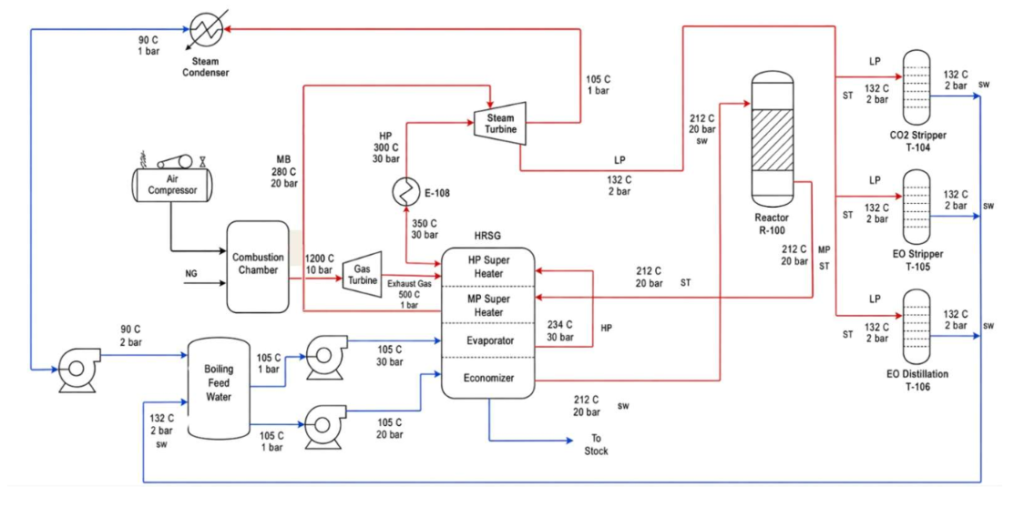
We studied the reboilers required for the separation columns and selected suitable configurations according to the duties and operating conditions of each unit. We then developed a steam and cogeneration system incorporating a gas turbine, a heat recovery steam generator, and a steam turbine.
This allowed us to consider how electrical power and process steam could be generated in an integrated manner rather than supplied as completely separate utilities.
We also designed the cooling and refrigeration systems. Because part of the air separation process required cryogenic temperatures, we proposed a closed-loop nitrogen reverse Brayton refrigeration cycle. In addition, we evaluated cooling-tower alternatives, performed preliminary cooling-tower sizing calculations, and examined the integration of air coolers and cooling-water systems.
Water management formed another important part of the plant design. We mapped the different types of water required throughout the facility, including raw water, cooling water, process water, boiler feedwater, and treated wastewater.
The resulting water network included raw-water treatment, reverse osmosis, boiler-feedwater preparation, cooling-water circulation, wastewater treatment, and opportunities for water reuse.

Process Control, Safety, and Environmental Responsibility
Safety was an essential consideration because ethylene oxide is flammable, toxic, highly reactive, and capable of forming dangerous mixtures under unsuitable operating conditions.
We examined the hazards associated with the main process materials and developed control strategies for the air separation columns, storage tanks, reactor, ethylene oxide absorber, carbon dioxide absorber, stripper, and final purification units.
These strategies included monitoring and controlling critical variables such as temperature, pressure, flow rate, composition, and liquid level. We also considered relief systems, emergency shutdown requirements, gas and leak detection, personal protective equipment, safe transportation, and structured hazard-analysis methods such as HAZOP.
The work helped us recognise that process control is not merely an automation problem. It is also one of the fundamental layers protecting people, equipment, the environment, and the continuity of production.


Environmental performance was evaluated through the identification of gaseous, liquid, and solid waste streams. These included carbon dioxide and nitrogen-rich gas streams, wastewater from the separation units, spent potassium carbonate solution, and spent silver-based catalyst.
For each major stream, we considered possible treatment, recovery, recycling, or disposal strategies. We also examined heat recovery, pressure-drop reduction, compressor optimisation, advanced process control, and the potential integration of renewable energy as part of a broader clean-production approach.
Could the Plant Be Economically Feasible?
After completing the technical design, we evaluated whether the proposed plant could also be economically viable.
We estimated the purchase and installation costs of the principal process equipment, including compressors, heat exchangers, columns, pumps, storage tanks, the reactor, cogeneration equipment, and the cooling system. These estimates were then combined with direct costs, indirect costs, working capital, raw-material expenses, utility consumption, labour, maintenance, and other manufacturing expenses.
Under the assumptions adopted in our design, the total capital investment was estimated at approximately USD 255.2 million. At full production capacity, the plant was projected to generate an annual revenue of approximately USD 333.8 million and an annual cash flow of approximately USD 49.4 million.
The resulting return on investment was calculated as approximately 9.34%, while the estimated payback period was slightly over five years.
These figures should naturally be understood as the results of a student-level conceptual design based on the prices, capacities, correlations, and assumptions used in our report. Nevertheless, carrying out the analysis allowed us to connect technical design decisions with capital expenditure, operating cost, profitability, and investment risk.

Choosing a Location and Designing the Plant Layout
For the final stage, we selected Arzew, Algeria, as the proposed location of the plant.
The selection was based on its position as an established petrochemical centre, access to raw materials and industrial utilities, proximity to Mediterranean port infrastructure, transportation possibilities, and access to European and North African markets.
After selecting the site, we developed a conceptual plant layout that separated hazardous process and storage areas from administrative and support facilities. The proposed layout included the main production area, air separation unit, utilities, raw-material storage, ethylene oxide storage and transport area, control room, laboratories, fire station, emergency-water tanks, administrative buildings, and an area reserved for possible future expansion.
This was the stage at which the project became visually recognisable as an entire factory rather than a collection of process equipment.

Presenting Our Design to Industry Professionals
The project concluded with an experience that made the final presentation particularly meaningful.
That year, the Department of Chemical Engineering at Gebze Technical University organised the Process Design Days together with the GTU Chemical Engineering Society GTU KMK. Instead of holding the design presentations solely as an ordinary classroom assessment, the department turned them into a two-day programme that brought students and industry professionals together.
Student teams presented the chemical plants they had designed, while invited professionals from organisations including Ersoy Holding, BASF, Akkim, Hyundai, and the World Energy Council delivered their own sessions between the student presentations.
Our presentation on ethylene oxide production took place on 11 May 2026. Presenting the project in front of an audience that included industry professionals gave the experience a different level of seriousness. The plant was no longer something we had designed only for our instructors and classmates. We had to communicate our assumptions, technical decisions, and overall engineering logic to people familiar with industrial processes.
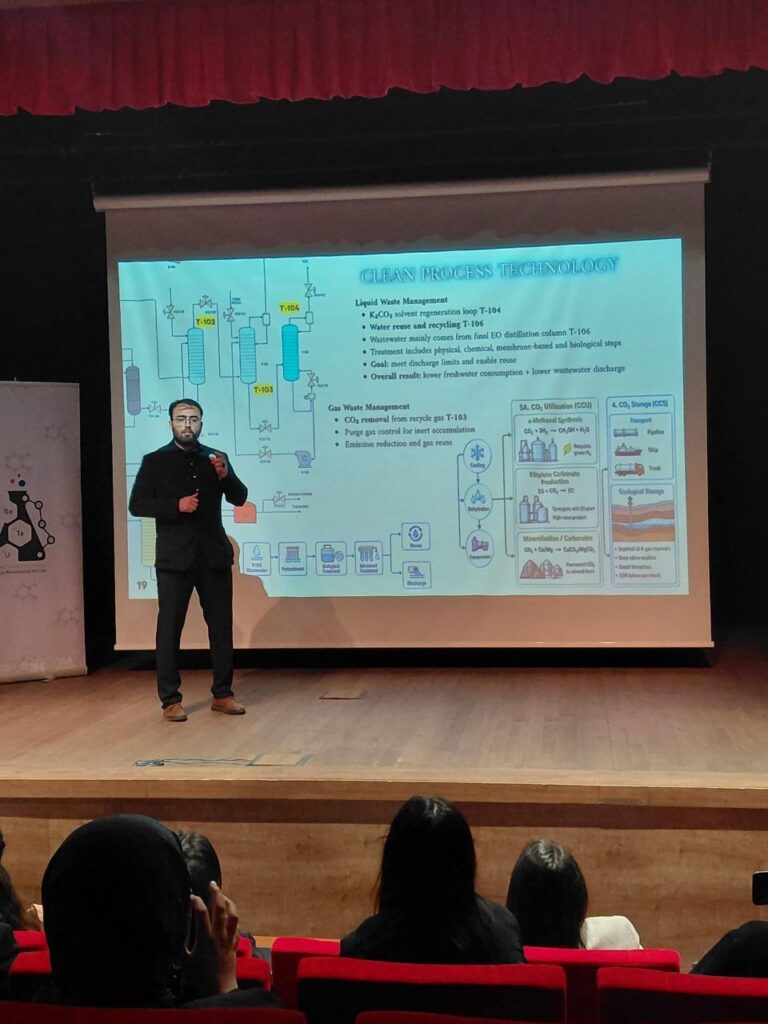
At the same time, listening to the invited speakers helped connect the calculations and diagrams in our report with real industrial subjects such as petrochemical trade, process operations, research and development, sustainability, digital transformation, project management, and economic decision-making.

In that sense, Process Design Days became more than the final presentation of a university course. It created a meeting point between chemical engineering education and professional practice.


Invited industry professionals participating in Process Design Days, jointly organised by the GTU Department of Chemical Engineering and GTU KMK.
Looking Back at the Two-Semester Journey
Across two semesters, this project took us from selecting a production route to evaluating an entire chemical facility.
We began with reaction chemistry, process simulation, mass and energy balances, and individual equipment design. We completed the journey by examining process intensification, steam and cogeneration, refrigeration, cooling water, water treatment, process control, safety, waste management, economic feasibility, site selection, plant layout, and quality assurance.
No conceptual design can reproduce every uncertainty and constraint of constructing a real industrial facility. However, the project taught me how chemical engineering subjects that are often studied separately come together within the boundaries of one plant.
Thermodynamics influenced energy consumption. Reaction engineering influenced safety and selectivity. Separation design affected utility requirements. Equipment decisions affected capital cost. Plant location affected logistics, infrastructure, and economic feasibility. Process control connected all these elements during operation.
More than the size of the final report, this systems-level perspective was the most valuable outcome of the experience.
Accessing the Complete Final Report
The complete second-semester report contains the calculations, comparisons, equipment evaluations, utility designs, control strategies, economic assumptions, environmental considerations, and plant-layout work summarised in this update.
📂 You can access the complete final report of our ethylene oxide production plant design through the link below.
(https://drive.google.com/drive/folders/17S8ZE8d7P8O5E7mcZj4d4Oo0tHx9WsFM)

1 yorum